both increases literally reversed the majority of the last 20 years decline in the effective tax rate of America’s 400 wealthiest taxpayers!
This week, the US House of Representatives will take up reconciliation legislation, amended and approved in the US Senate last month, that would drill major, damaging holes in the Affordable Care Act. Though the bill has zero chances of becoming law because of a certain veto by President Obama, it is – by the Democrats’ count – the 61st time the House has voted to repeal all or significant parts of the health reform law.
Why, people often ask me, do Republicans hate the ACA so much?
This past week’s New York Times Upshot article, I believe, provides a major part of the answer. Briefly, “it’s the taxes on the wealthy, stupid.” Specifically, it’s about two new Medicare taxes that went into effect in 2013 only on higher income Americans:
ACA Medicare Part A Payroll Tax: Beginning in 2013, individuals with earnings above $200,000 and married couples making more than $250,000 got an increase in the Medicare part A payroll tax of 2.35%, up from 1.45% (a .9% increase), on adjusted income over the threshold. (2016-25 take = $123 billion)
ACA Unearned Income Tax: This same group also now pays a new 3.8% unearned income (capital gains) tax on interest, dividends, annuities, royalties, rents, and gains on the sale of investments over the threshold. (2016-25 take = $222.8 billion)
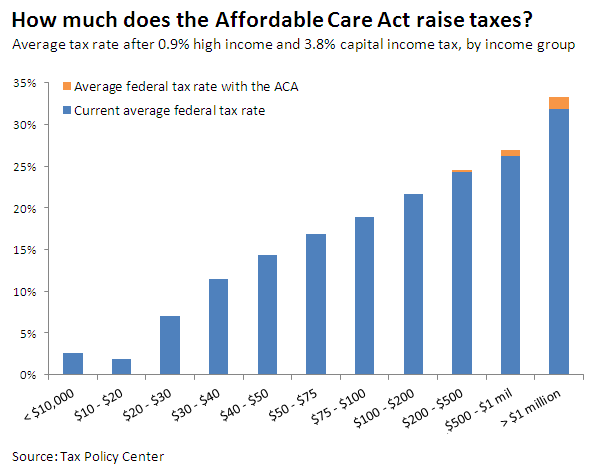
It’s a lot of money and it’s a lot of money taken exclusively from the top 5% of America’s wealthiest, ($345.8 billion between 2016-25) and especially from the most wealthy as the chart below demonstrates:
As the Times article makes clear, these new taxes are so damn big (when combined with higher taxes from the 2012 American Taxpayer Relief Act) that both increases literally reversed the majority of the last 20 years decline in the effective tax rate of America’s 400 wealthiest taxpayers! Continue reading “Why Republicans Hate the ACA So Much”
On one thing all Affordable Care Act watchers can agree: This autumn saw important developments and changes relating to the nation’s health reform law. How much and how serious? Any immediate assessment is incomplete and the full impact only will be evident through the lens of the 2016 presidential and Congressional election results. Until then, some impacts are clear. So let’s consider…
First, what has happened? Here is my list of key developments:
Congress delayed or suspended for one or two years the operation of three taxes that help finance the ACA: the so-called “Cadillac tax” on high-cost employer-sponsored health insurance policies; the medical device industry tax; and the health insurance provider tax.
The House and Senate are close to final agreement (coming in January) to use the budget reconciliation process to repeal major, critical portions of the ACA, legislation that President Obama will veto and will see his veto sustained.
14 of 23 co-op health insurance plans created from the ACA have collapsed; also, UnitedHealthcare is dropping out of the ACA market.
The third Open Enrollment process is proceeding smoothly with larger than expected numbers signing up for coverage – final numbers yet to come.
On Medicaid, more holdout states are warming up to accepting the ACA expansion, and Kentucky’s new Tea Party governor has abandoned his campaign commitment to repeal that state’s expansion.
More and more experts, from both sides of the ACA divide, are advancing robust and noteworthy proposals for ACA replacement or improvement.
[This post was originally published on December 4th on the Health Affairs Blog. It was co-written by me and Max Fletcher, a student at the Harvard TH Chan School of Public Health.]
The November 3 election of Matt Bevin as governor of Kentucky will provide an important indication of the seriousness of Republican intentions to undermine and repeal the health insurance expansions of the Affordable Care Act (ACA). Early in Bevin’s campaign, he expressed unambiguous intent to repeal Governor Steve Beshear’s executive order that expanded Medicaid; during the general election campaign, Bevin backpedaled and proposed adopting an Indiana-like Medicaid waiver to require significant enrollee cost sharing and an enrollment freeze. Bevin also prefers to close the successful Kynect health insurance exchange and transfer operating duties to the U.S. Department of Health & Human Services.
Whatever the outcome, the moves by the Tea Party-endorsed new governor will provide the best preview of what the nation may expect if Republicans take control of the White House and retain majorities in the Senate and the House of Representatives in January 2017. Many eyes will watch Governor Bevin’s health care moves from across the political spectrum. Continue reading “The $879 Billion Footnote — And The Financing Path To ACA Repeal”
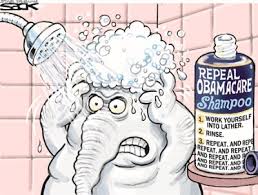
For the 61st time since 2011, Congressional Republicans are moving legislation to undermine and dismantle key elements of the Affordable Care Act (ACA). This time, though, will be different.
First, this will be the first time Republicans will use the budget process known as “reconciliation” to advance repeal. Using a budget reconciliation bill prevents Democrats from filibustering the legislation in the Senate, meaning only 51 votes are needed for passage in expedited debate.
Second, this will be the first time that the House and Senate both pass similar legislation to damage the law. As a result, this will be the first time that anti-ACA legislation will reach President Barack Obama’s desk. The President’s veto of this measure is guaranteed, as are the needed votes in the House and Senate to sustain his veto. So this will be another exercise in ObamaCare-Kabuki Theater with some new twists.
(This article was published on Friday, September 18 on the Health Affairs Blog. It was prepared by me and Max Fletcher, a Master of Public Health student at the Harvard TH Chan School of Public Health.)
A new spate of proposals from Republican presidential candidates to repeal and/or replace the Affordable Care Act (ACA) raises the important question: Given an unobstructed opportunity, what would Republicans really do with the Affordable Care Act? Would they repeal the law wholly or just in part? With what might they replace it?
Some suggest that Republican Congressional leaders only advance full repeal to placate their Party’s conservative base, knowing well that repeal cannot survive a certain veto while Barack Obama is President. In January 2017, that obstacle will vanish if Republicans control the White House and both branches of the U.S. Congress. What then?
Unfortunately, the proposals now being advanced by the Presidential candidates are far less than comprehensive, and leave many more issues unanswered than answered.
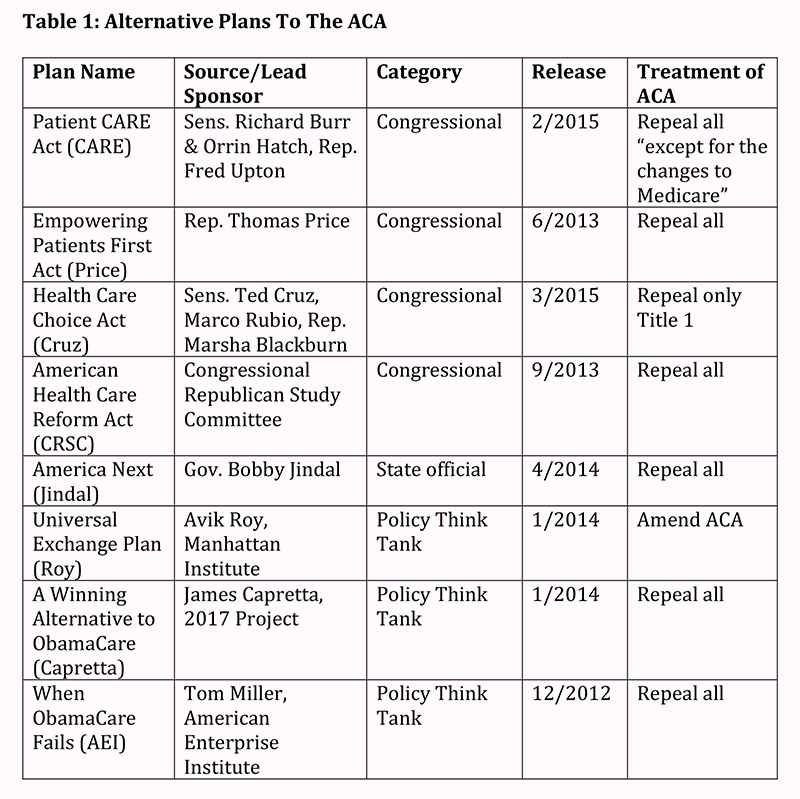
Though no ACA replacement plan has progressed in either branch (or in any standing committee) of Congress since the law’s 2010 signing, Republican office holders and conservative think tanks have advanced expansive proposals. We identified eight plans offered between 2012 and 2015 that address the ACA’s fate and propose substantive replacement. We examined each in detail to determine the extent of agreement on alternatives to the ACA. We created a chart comparing the eight proposals according to key policies. Table 1 below provides identifying information about the eight plans:
Of the eight proposals, four were advanced by Republican Members of Congress. The most prominent of these is the Patient CARE Act offered by Sens. Richard Burr (R-NC) and Orrin Hatch (R-UT) and Rep. Fred Upton (R-MI); the latter two are the current chairmen of the Senate Finance Committee and the House Committee on Energy and Commerce respectively, both committees with primary ACA jurisdiction. Though narrative versions of Burr-Hatch-Upton were released in 2014 and 2015, the authors have not translated their proposal into legislative language that can be evaluated by the Congressional Budget Office (CBO). While the other Congressional proposals have been introduced as legislation, none have received CBO scores. Continue reading “What Would Republicans Do Instead of the Affordable Care Act?”
A provision of the Affordable Care Act popularly – or unpopularly – known as the “Cadillac Tax” is getting lots of attention now, even though it doesn’t take effect until 2018. Voices from both parties want quick repeal. And the politics are strange.
Briefly, the tax is a 40% excise on high cost health insurance policies that cost more than $10,200 for individuals and $27,500 for families in 2018. It’s 40% on the increment, so an individual policy costing $11,200 would cost an extra $400. It was included to help finance the ACA’s cost and to apply pressure where it hurts the most to restrain the cost of health insurance.
When the ACA was signed into law in 2010, many critics asked: “where’s the cost containment?” One answer was: “the Cadillac tax.” The frequent response was derisive laughter: “The tax doesn’t hit until 2018 and it will be repealed well before then.” No laughter now. Continue reading “The Curious Politics of the “Cadillac Tax””
If you were among the few looking closely, you may have noticed buzz and hoopla this past week on the release of two health reform proposals from Republican presidential candidates Gov. Scott Walker (R-WI) and Sen. Marco Rubio (R-FL). Not surprisingly, while Affordable Care Act supporters were quick to criticize, ACA detractors were complimentary: “serious plans” and “the opening theme music of health policy reform for Republican presidential primary voters.”
So, how do these two plans stack up? Not well. Here’s a handy table with which you can compare – and I’ve left nothing of out:
“Demand that we repeal Obamacare and replace it with a conservative solution.” (website)
Tax Credits to Purchase Health Insurance
“Available to anyone without employer coverage based coverage” – the amount based on age only:
0-17: $900
18-34: $1200
35-49: $2100
50-64: $3,000
“… advanceable, refundable tax credit that all Americans can use to purchase health insurance…”
Access to Health Savings Accounts (HSAs)
Anyone signing up for an HSA gets a $1000 refundable tax credit
“…should be expanded.”
Sale of Health Insurance across State Lines
Allow individuals to shop in any state for insurance
N/A
Pre-Existing Conditions
Banned for individuals who “maintain continuous creditable coverage”
“Those with pre-existing conditions should have access to affordable care through mechanisms such as federal-supported, actuarially-sound and state-based high risk pools.”
State High-Risk Pools
“…make it easier for states to expand these pools”
See above.
Mandated Essential Health Benefits, including for Young Adults <26
“…return regulatory authority to states”
N/A
Medicaid
Capped state allotment for: 1. Low-income families 2. Non-disabled adults; 3. Long term services & support
“… move … into a per capita system preserving funding for Medicaid’s unique populations while freeing states from Washington mandates.”
Insurance Pooling
“… allow for new purchasing arrangements so farmers, small business, religious groups, individual membership associations and others could join together…”
N/A
Long Term Care Insurance
Deregulate the current market
N/A
Medical Malpractice
“… incentivize states to pass meaningful lawsuit reform…”
N/A
Financing
“… repeal all of ObamaCare’s $1 trillion in new taxes…” No specifics on substitute financing.
N/A
Tax treatment of employer provided health insurance
N/A
“Glide path” downward to match the value of individual tax credits within a decade
Medicare
N/A
“A premium support system, empowering seniors with choice and market competition, just like Medicare Advantage and Part D already do.”
The report’s basic and important message is this: though it has vastly increased health insurance security and affordability for millions of vulnerable Americans, the Affordable Care Act is not affordable enough. Knowing what we know now, the law needs better affordability for millions of Americans who need access to subsidized insurance that includes more affordable premiums and stronger cost sharing protections:
“The premium and cost-sharing structures established under the law were delineated with the intention of meeting specific budget targets that now seem overly constraining. As a result, several problems occurred. Premium tax credits are substantial, but they are still inadequate for many individuals and families, given their incomes. Similarly, many individuals with modest incomes may struggle to afford the Level of cost-sharing required in the plans for which the premium tax credits are pegged. Premium tax credits are tied to a product with cost-sharing requirements that significantly exceed the typical large employer-sponsored plan. In particular, older individuals with incomes just above the current tax credit eligibility range face high premiums relative to their incomes, and because they tend to use more medical care than do their younger counterparts, they face a total bill for premiums plus out-of-pocket spending that can be very high.”
I had one mission last evening watching the Republican-Fox News debate among their party’s top ten presidential contenders: what, if anything, could we learn about the state of play regarding the Affordable Care Act and U.S. health policy?
What I observed: the impassioned debate about the Affordable Care Act/ACA/ObamaCare is over, even among Republicans.
Here is what I noted from the debate that referenced the ACA:
First, Ohio Governor John Kasich restated his strong support for his decision to expand Ohio’s state’s Medicaid program as enabled and financed by the ACA, invoking President Ronald Reagan as someone who “expanded Medicaid three or four times.” He emphasized how the expansion helps both Ohio’s working poor as well as the mentally ill in prisons. No apology, no retreat, and no damage or attacks from any of his rivals.
Second, asked about his prior public support for a Canadian-style single payer health care system, Donald Trump commented that “single payer works well in Canada and incredibly well in Scotland.” He said he wants a “private system without artificial lines around states” (so much for states’ rights) and opposes “insurance companies that make a fortune because they have total control of the politicians. Get rid of the artificial lines. Take care of the people who can’t take care of themselves.” Oddly, at the end of his closing statement at the very end of the program, he added, apropos of nothing: “We have to end Obamacare and make our country great again.”
Former Florida Governor Jeb Bush said he wants to “get rid of Obamacare and replace it with something that doesn’t suppress wages.” No indication of what the “something” might be.
Wisconsin Governor Scott Walker simply said he wants to “repeal Obamacare.”
That’s it. Except for Trump’s, none of the others’ closing statements mentioned the issue. Even Texas Senator Ted Cruz, in his lengthy litany of first-day-as-President actions, left executive action on the ACA off his list. Cruz, as many will recall, was the key instigator of the 2013 federal government shutdown as a final gasp to prevent implementation of the ACA’s insurance coverage expansions on January 1 2014.
The only question from the panel of three Fox news journalists relating to health reform was the one to Trump regarding his past support for single payer health insurance – more a Fox gotcha moment than a thrust into health policy.
I looked at dozens of news accounts of the program from journalists across the political spectrum. Obamacare/ACA merited no mention anywhere in the their accounts and analyses.
This is the sound of silence as the ACA disappears from the nation’s political radar screen.
Yes, U.S. health policy is becoming boring again, still a never-ending feast for the policy wonks, still a continuous hand-wringing exercise for patients and medical providers dealing with their daily challenges, and now a big nothing-burger for most Americans focused on other concerns.
On two other health related issues, we heard repeated statements of opposition to public funding for Planned Parenthood and, of course, strident statements of opposition to abortion where the focus put candidates on the defensive who are willing to allow abortion in cases of rape, incest, and to save the life of the mother.
And nothing about Ebola!
I am sure in future debates, the ACA will return and receive a higher profile. But temperatures are cooling and this program last evening was important affirmation.
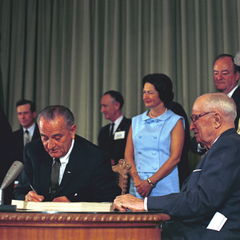
Fifty years ago this Thursday, July 30th 1965, President Lyndon Baines Johnson signed into law legislation creating two new national health insurance programs, Medicare and Medicaid. Fifty years later, these programs appear as recognizable and durable as any monuments in Washington DC. That’s an illusion because there’s little difference between the Lincoln and Jefferson Memorials today versus 1965. On the other hand, Medicare and Medicaid today look radically different from the law signed by LBJ as former President Harry Truman looked on.
If there is one constant in Medicare and Medicaid, it is change — constant, persistent change to fit the needs and preferences of the time. Both programs have been works in progress for 50 years, and so it continues.
The law’s original metaphor, coined by then-House Ways & Means Chairman Wilbur Mills (D-AR), was the “three layered cake.” The bottom layer was Medicare Part A — the original Democratic proposal for hospital insurance, funded by new employer/employee Social Security taxes deposited in a new Part A Hospital Insurance Trust Fund. When reference is made to “Medicare going broke,” it means this Trust Fund. When debate over the legislation that became the Affordable Care Act/Obamacare began in 2009, the Fund was scheduled to have insufficient funds by 2017 — last week’s new Trustees’ report now pegs the Fund’s financial reserves as solid through 2030.
OLYMPUS DIGITAL CAMERA
The second/middle layer was Medicare Part B — payment for physician services, funded by enrollee premiums and government revenues. During the original Medicare debate, Democrats wanted what became Part A and Republicans pressed for what became Part B. It was Wilbur Mills’ inspiration to combine them into a single program. This past March, Congress passed a new law overhauling physician payment in Part B. Parts A and B make up what is often called “Traditional Medicare,” a federal insurance program with no state government involvement.
The third layer was Medicaid — a new federal-state program to provide medical benefits for low income mothers and their children who were on “welfare” or public assistance. The law required the feds to set national rules and left administration to states with lots of discretion. A more appropriate metaphor — less tidy than Mills’ — would have been to describe Medicaid as 51+ (including DC and US territories) marbled cupcakes. The saying goes: “if you’ve seen one state Medicaid program, you’ve seen one state Medicaid program.” Because of changes brought by the ACA, Medicaid today is more a national program with uniform standards than ever — still it is 51+ marbled cupcakes, each one different from the rest.
In 1965, Medicaid was an afterthought — a make-shift, temporary caboose on the bold, new federal Medicare system that many expected/hoped would expand to cover all Americans within several years. In his definitive book on Medicare’s creation, “The Politics of Medicare,” Ted Marmor did not even mention Medicaid. Today’s ACA-reformed Medicaid covers more than 70 of 320 million Americans (Medicare covers about 54 million). It is the nation’s largest health insurance program covering 40% of all our children and paying for 40% of the nation’s births, the largest payer for nursing home and long-term care, and so much more. Sure, 19 states are still refusing to expand Medicaid as permitted by the ACA. History tells us they will come around — the last state to join original Medicaid was Arizona, and not until 1982, 17 years after the program’s creation! I continue to predict that all 50 states will be in no later than 2020.
More than Medicaid, though, Medicare has become the undisputed driver of health system reform in the US and around the world. In the 1965 law, Medicare was required to pay hospitals and physicians their “usual, customary, and ordinary” fees, a mega-inflationary scheme if there ever was one. In 1983, under “conservative” President Ronald Reagan, Medicare became the world’s biggest government agent for administered prices with the creation of the Inpatient Hospital Prospective Payment System (PPS), with Diagnostic Related Groups (DRGs) as the price-setting tool. Today, DRGs are one of the most familiar hospital payment forms around the globe.
Today, Medicare is much more than traditional A+B. It now includes C+D — (“new” Medicare). C has had several names during its 40+ year history, prominently “Medicare+Choice” between 1997 and 2003, and today’s “Medicare Advantage” by which enrollees get Medicare benefits managed by a private health insurer, now covering about one third of all Medicare enrollees. Part D was established by Congress in 2003 to provide, for the first time, an outpatient prescription drug benefit for enrollees managed by private drug plans. There’s no mandate, but if enrollees don’t sign up when first eligible, they pay increasingly higher premiums for the rest of their lives! But it’s not a mandate, so they say.
Understanding the politics of Medicare is much more straightforward if you remember this: Democrats like A+B, traditional Medicare because it is government-paid fee-for-service which keeps insurance companies out of the picture (except for Medigap coverage — another topic!) and tend to dislike C+D because of these programs’ reliance on private health insurers. By contrast, Republicans detest A+B as government bureaucracy, and love C+D because both rely on private insurers. Understand this, and everything becomes easier. Below, I also add Medicaid and the Exchanges to the political mix.
Your Easy Guide to the Politics of Federal Health Programs
Democrats
Republicans
Medicare A+B (traditional Medicare)
+
–
Medicare C+D (new Medicare)
–
+
Medicaid
+
–
ACA Health Exchanges
+
?@%&!
Republicans also tend to loathe and despite Medicaid because it is government provided health insurance. One irony is that, today, most states require that Medicaid enrollees get their coverage through private Medicaid managed care plans run by private insurers. Go figure.
While the ACA established yet a third pillar to the US health landscape in the form of Health Insurance Exchanges/Marketplaces to provide subsidized private health insurance to Americans unable to get insurance elsewhere, Obamacare also made dramatic changes to both Medicare and Medicaid, reinforcing my premise that these program always have been, and continue to be, works in progress.
The ACA not only expanded greatly who is eligible for Medicaid (to all non-elderly with incomes below 138% of the federal poverty level [$15,654 in yearly household income for a single adult]), it established for the first time national eligibility and enrollment standards. Though the Obama Administration is permitting all manner of experiments in conservative states (i.e.: Arkansas, Iowa, Indiana) hoping to “get to yes” on eligibility expansion (because of the 2012 US Supreme Court decision that made the ACA expansion an option rather than a requirement for states), Medicaid looks more like a national program today than ever before.
Meanwhile, the ACA accelerated Medicare’s role as a national delivery system reform engine through initiatives such as Accountable Care Organizations (ACOs), bundled payments, penalties on hospitals with high rates of readmissions and patient injuries, and much more. In US health policy today, Medicare is driving the reform agenda as the private sector follows and innovates in Medicare’s footsteps.
As someone who follows US health policy developments closely, I am constantly amazed by the daily and incessant deluge of news relating to both Medicare and Medicaid. Lots of these stories offer hyperbolic predictions of impending doom and calamity — this one I read today by Joe Antos of the American Enterprise Institute predicts that Medicare will be the next Greece!
Fifty years of Medicare and Medicaid and the pace of change just keeps accelerating — for better and worse. While many Americans fervently wish we could just have one solid federal health insurance pillar, now we’ve got three (not even counting the Veterans Administration and Tricare). I’m an optimist and believe that our system is getting better. I think that’s true most and not all the time. What’s undeniable is that our major health programs are works in progress, constantly moving and changing.
Here’s hoping that in the next 50 years, we will find a more stable and durable solution for all Americans.






 Health Stew