Health and Taxes and the Values at Stake in the ACA Debate

[This commentary was published this week on the website of the Milbank Quarterly.]

One of my favorite political scientists, Deborah Stone, wrote that much of the policy process involves debates about values masquerading as debates about numbers and facts.1 Although her construct is abundantly in evidence, it is being overlooked in the current debate over the future of the Affordable Care Act.

How much are premiums rising? How many plans are operating in the exchanges? How much money are accountable care organizations saving? What impact would a per capita cap financing scheme have on Medicaid? How much has the ACA restrained or propelled health cost growth? What do opinion polls show?

Each side furiously hurls data and anecdotes at each other as if by identifying the killer data point, the other side would throw up its hands in surrender and declare: “How could we have been so dumb?” Of course, this never happens in public policy debates. It never happens because numbers and anecdotes don’t motivate people on an issue as charged as the ACA. Values do. Continue reading “Health and Taxes and the Values at Stake in the ACA Debate”

The State of Play Post-Trump/RyanCare

[This column is reprinted from the Commonwealth Magazine website.]

GLOBAL HEALTH EXPERT Michael Reich says that the acid test of any national health reform comes when a new national administration takes over. Only when a new president or prime minister assumes power can we judge the stability and staying power of any health system reform. In the US, that’s this moment. Since November 8, we’ve been learning what parts of the Affordable Care Act (ACA) have staying power, which do not, and what’s uncertain.

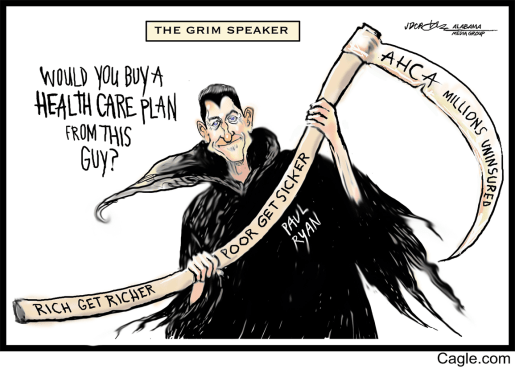
Right now, after Friday’s demise of the Republican repeal and replace plan, the American Health Care Act (AHCA), we know that Medicare, Medicaid, insurance market reforms such as guaranteed issue, and delivery system reforms such as accountable care organizations look TrumpCare3

safe. We know that the private insurance coverage reforms – insurance exchanges, premium and cost-sharing subsidies, the individual mandate – are at risk and in danger even though they dodged full repeal with the AHCA’s demise. And we don’t know the fate of the ACA’s many tax increases. Let’s view these systematically. Continue reading “The State of Play Post-Trump/RyanCare”

24 Million May Lose Health Insurance to Pay for Tax Cuts for Wealthy Americans

[This commentary, “GOP Cuts Are Moral Challenge for America,” was published on Commonwealth Magazine’s website on March 14.]

THE BIG NEWS IS, of course, Monday’s “score” from the Congressional Budget Office detailing that the House Republican bill to repeal and replace the Affordable Care Act/Obamacare will result in 14 million Americans losing health insurance by 2018 and 24 million by 2026.

Before that, something else caught my eye from the Bangor Daily News. It’s a blog post from a woman named Crystal Sands who writes about how the ACA enabled her and her young family to take a chance and find a new life as farmers. Her post, “The ACA makes a simpler farming life possible for our family,” says this:

“I’m a writer, an online professor, a farmer, a wife, and a mom. None of these jobs offer health insurance for me and my family, so our family purchases our health insurance through the Affordable Care Act. We work hard, but we try to work differently. If you read my blog, you know we’re learning to grow and raise our own food, and our health insurance through the ACA makes this possible.

“The ACA has helped me to become a better mom, a better wife, a better teacher because I am not so overworked, and it has made it so I can learn to be a farmer. I’m also just a better person. I’m not sick and overworked. I’m more patient and more kind and more helpful to everyone. And this is my story. There’s so much potential here to make lives better. There are many people, including many farmers, who depend on the ACA. I hope we don’t lose sight of that.

And now, CBO’s Cost Estimate of the American Health Care Act. Bottom line — $894 billion in tax cuts financed by $1.2 trillion in cuts to Medicaid and to subsidies/tax credits for private health insurance. Those cuts will produce an increase in numbers of uninsured Americans of 14 million by 2018, 21 million by 2020, and 24 million by 2026. Of the 24 million, 14 million will lose Medicaid and 10 million will lose private coverage, employer-sponsored and individual. Continue reading “24 Million May Lose Health Insurance to Pay for Tax Cuts for Wealthy Americans”

House Republicans Show Their Hand on ACA — and It’s Not Good

[This February 26 2017 commentary was published on the Commonwealth Magazine website.]

LATE LAST WEEK, Politico released a leaked 105-page draft bill defining the House Republican plan to repeal/replace/repair/re-whatever the Affordable Care Act/Obamacare. The draft legislation was dated February 10, so likely it’s already out of date, though it is the best indication yet of their rapidly evolving intentions and fits with many of their prior recent proposals. So a big GOP move is getting close, and it’s not good. What’s important?

First, the ACA’s generous coverage expansion (for many, not all) through Medicaid expansion and private insurance subsidies would be drastically curtailed, leaving most of the 22 million who got either form of coverage without an affordable option.

repeal-replace-720

Second, not only is the ACA Medicaid expansion repealed by 2019 (11 million people and counting), the plan would replace current Medicaid financing with a “per capita cap” by 2019, shrinking funding by hundreds of billions, perhaps more, over 10 years. Continue reading “House Republicans Show Their Hand on ACA — and It’s Not Good”

“It has saved my life.” Voices from Ohio on Medicaid Expansion

[This commentary was first published on February 15 on the Commonwealth Magazine website:]

OHIO IS ONE of 31 states that expanded Medicaid as permitted by the Affordable Care Act/Obamacare for nearly all low-income citizens. The state’s Republican governor, former presidential candidate John Kasich, has been among the most vocal proponents of the expansion on the Republican side and has taken a lot of grief for it from ACA opponents.

In early January, the state released an evaluation of the impact of the expansion, “Ohio Medicaid Group VIII Assessment: A Report to the Ohio General Assembly“. (Group VIII is the legal name for the ACA Medicaid expansion population.)

ohio-medicaid

The report has a host of quotes from interviews with individuals who benefited from the expansion, and I include a selection of these quotes below, along with a section from the report’s overall summary. This is what Medicaid expansion has meant to real Americans:

“It gives me peace of mind knowing that I don’t have to pay for the medical insurance, and it saves me money being able to afford food and utilities and everyday things you need in life.”

“It’s been a blessing and I thank God that I have Medicaid because I no longer have large payments and I can get my Medicaid medicines.”

“More freedom. Less worries. I was an addict for 3 years before getting Medicaid. Because of Medicaid I’m not an addict.” Continue reading ““It has saved my life.” Voices from Ohio on Medicaid Expansion”

Welcome Back to the Medical Underwriting Circle of Hell

[This commentary was posted today (2-15-2017) at RealClearHealth.]

All leading Republicans who are committed to repealing all or key parts of the Affordable Care Act (ACA) also emphasize their commitment to maintaining the law’s most popular part: banning pre-existing condition exclusions and medical underwriting by preserving the ACA’s (also known as Obamacare) policy of “guaranteed issue.” But the fine print in Republican proposals betrays that commitment, including legislation filed on January 26 by House Energy and Commerce Committee Chairman Greg Walden (R-OR) threatening health security for tens of millions of Americans.

Medical underwriting is the insurance industry practice of issuing and pricing health insurance based on an individual’s current or prior medical condition. Insurers use medical underwriting and pre-existing condition exclusions to avoid covering anyone who might cost them money. The Walden bill, called the “Preexisting Conditions Protection and Continuous Coverage Incentive Act,” pretends to continue the ACA’s ban on medical underwriting, but would, in reality, do the opposite.What are pre-existing conditions that can prevent you from obtaining coverage?

What are pre-existing conditions that can prevent you from obtaining coverage? Here is a list of hundreds that are used to exclude or limit health insurance: acne, cancer, domestic violence, leukemia, pregnancy, sleep apnea, and much more. Continue reading “Welcome Back to the Medical Underwriting Circle of Hell”

Vive la ACA Resistance!

[This commentary was published on the Commonwealth Magazine website last week.  If you are supportive of what the Affordable Care Act has achieved and want to help defend it — the time is NOW.  Please go to: http://protectmycare.org/ to learn how you can help, now. Everyone.  Please.]

A NEW REPUBLICAN-CONTROLLED Congress is in place. And for the sixth time, the Affordable Care Act (ACA) is facing extinction. Indeed, a gripping narrative history of the ACA/Obamacare could be written focused only on its numerous near-death experiences. Maybe the sixth time will be the curse, and maybe not. Let’s recall.

One, in January 2010, the loss of the 60th Democratic vote in the US Senate via the election of Republican Scott Brown to the seat formerly held by Massachusetts Sen. Edward Kennedy was almost universally assumed to be the end of the road for President Obama’s health reform agenda. He signed the ACA into law two months later.vive-la-resistance

Two, in June 2012, by a single vote, the US Supreme Court upheld the constitutionality of the ACA’s individual mandate and, by extension, the ACA. On the day of the decision, premature news accounts by CNN and Fox News erroneously reported that the court had overturned the law.

Three, in November 2012, thorough ACA repeal would have followed an electoral win by Republican Mitt Romney in that year’s presidential election, well before full implementation in 2014.

Four, between October-December 2013, catastrophic launches of the federal and state Health Exchange websites temporarily made the law a national laughingstock facing stillbirth at its most critical setup moment. The debacle was accompanied by a three-week October shutdown of the federal government in a final Republican spasm to prevent January 1, 2014, implementation.

Five, in June 2015, a second potentially fatal lawsuit that reached the US Supreme Court was laid aside by a 6-3 vote.

Six and lastly, the November 2016 federal elections represented the final life-threatening challenge.  An expected presidential victory by Democrat Hillary Clinton would have sealed the law’s lifespan at least until 2021. Instead, Republican Donald Trump’s victory now is leading many, once again, to predict the law’s effective demise this year.

Except, it ain’t necessarily so.  Here are three reasons why.

First, the Republicans’ ACA playbook is riddled with contradictions and dissent over their “repeal and delay” strategy.  Will delay last two, three, or four years? Once they repeal the law’s financing, how can they pay for even a minimal replacement? Will they do one replacement or a series of replacement bills? How can they keep private insurance companies from abandoning the individual insurance market in soon-to-be demolished health exchanges?  How will they keep preposterous promises that their still-unknown replacement will provide better coverage at lower cost for everyone who has been helped by the ACA? How will they keep Republican governors in line as they seek to slash Medicaid spending by approximately $1 trillion dollars over 10 years? These are just for starters.

For a devastating look at the contradictions in “repeal and delay,” see this week’s Health Affairs blog by conservative analysts Joseph Antos and James Capretta: “The Problems with ‘Repeal and Delay.’” “The most likely end result of ‘repeal and delay,’” they write, “would be less secure insurance for many Americans, procrastination by political leaders who will delay taking any proactive steps as long as possible, and ultimately no discernible movement toward a real marketplace for either insurance or medical services.”

Second, as Americans now focus on Republican non-plans and non-answers, public opinion is turning against them. Recent Kaiser Family Foundation polling shows that even Trump voters – who are far more chronically ill and needy than Clinton backers – support nearly all of the ACA’s essential building blocks except for the individual mandate, and oppose repeal without a replacement plan. As Noam Levey from the Los Angeles Times has shown, not a single nationally recognized patient or health care provider organization supports the Republican repeal agenda. Only the fringes of the Tea Party stand by their sides in this backward quest.

Third, while defenders of Republican drive to end coverage for between 22 to 30 million Americans are few and far between, broad resistance to the first major policy thrust of the Trump era is building.  A broad-based “Protect Your Care” coalition is spearheading national resistance, collaborating with President Obama and congressional Democrats and leading to a day of demonstrations across the nation on January 15. Hospitals, doctor and medical student groups, insurance companies, community health centers, and other health care stakeholders are making clear the damage now threatening the entire US health care system. Meanwhile, former Democratic congressional staffers have developed a blueprint for broad-based resistance to the Trump/Republican agenda, called “Indivisible.”

Republicans may win, though they will rue the day that they set in motion destabilization of the nation’s health care system. Around the globe, universal health coverage is now recognized not just as something governments do to be nice to their people, it is understood as an essential precondition for healthy societies and healthy economies. Over the past eight years, the United States has been moving forward to join the universal consensus of advanced nations, most of whom are far less affluent than the US.

Whether Republicans succeed or fail is not just up to them. It is now up to all Americans. Vive la ACA resistance!

Five Affordable Care Act Questions for the GOP

[This commentary was published today on the website of Commonwealth Magazine.]

SO, REPUBLICANS ARE planning a major blitz to repeal and delay/replace/collapse the Affordable Care Act/ACA/ObamaCare. I’ve got five questions to ask leaders of the Grand Old Party.

First, if your guarantees are honest that your replacement law will be better than the ACA, why not share real numbers?

President-elect Donald Trump, Speaker Paul Ryan, and Majority Leader Mitch McConnell have each promised that their ACA replacement will cover as many Americans as the ACA with higher quality and lower costs. Bully for that!

Here’s the problem. None of the plans you’ve produced, including the 2016 Reconciliation bill, Trump’s platform, Ryan’s Better Way, Health & Human Services Secretary designee Tom Price’s Empowering Patients First plan, or others from Republicans and conservatives, comes close. Except for this year’s reconciliation bill, none has been submitted to the Congressional Budget Office for a score. Reputable analysts peg the drop in insured lives between 20-30 million currently insured.wash-monu

Your message is “trust us.” Would businessman Trump take such a deal?

Second, when you promise to continue “guaranteed issue” of health insurance with no-pre-existing conditions or medical underwriting, why do you always fail to mention the fine print?

Trump, Ryan, and other Republicans’ statements are clear – any reform will maintain “guaranteed issue.” Yet your written plans tell another story – guaranteed issue will be kept only for persons who maintain “continuous coverage” (undefined). This means if you lose your insurance and have a coverage gap beyond the allowed time, you will be newly subject to medical underwriting and pre-existing condition exclusions for an unspecified period (forever?).

How many people might fall into this new medical underwriting Circle of Hell (CoH)? Start with 28-29 million currently uninsured, add the estimated 20-30 million increase because of Republican plans to eliminate income-based premium subsidies. We start at 48-58 million Americans, and the numbers will only grow as more fall into the medical underwriting CoH.

This is detailed in numerous replacement plans, including Ryan’s. Yet you never mention this life-important detail when talking with media who buy your line that you will continue the ACA’s elimination of pre-existing conditions for everyone. Untrue.

Third, what will you do about enormous losses for those dealing with substance abuse and mental health needs under your plans?

Most Americans don’t realize that the ACA is the biggest law ever in covering Americans for substance abuse and mental health services (aka: behavioral health). It’s true. ACA guaranteed issue means no one can be denied insurance because they had or have substance abuse/mental health problems. Bans on lifetime and annual benefit limits allows countless persons with expensive substance abuse or mental health disorders to keep covered.  Requiring insurers to cover 10 “essential health benefits” insures that nearly all Americans have behavioral health coverage (#5) PLUS prescription drugs (#6) to treat their disorders.

All Republican plans – Trump, Ryan, Price etc. – propose eliminating “essential health benefits.” They propose eroding guaranteed issue (see above) and canceling elimination of annual benefit limits. So, the ACA’s enormous advances for  mental health and substance abuse would become major losses under Republicans’ plans. I’m not sure you get this at all.  I am certain most Americans have zero idea of this and they will strongly object when they find out.

Fourth, why are you so mean to the nation’s hospitals? 

In crafting the ACA, America’s hospitals committed a mortal sin in Republicans’ eyes by making a deal with President Barack Obama and the US Senate. In exchange for Democrats’ commitment to get as close to universal coverage as politically possible, hospitals agreed to $155 billion in federal payment reductions between 2010-19 (now about $350 billion between 2016-2025). They did this to stop being the default caretakers of America’s uninsured.

Now Republicans plan to repeal the ACA’s new taxes on wealthy Americans, on drug, medical device, and health insurance companies, even on indoor tanning salons! And, they plan to leave in place the $350 billion in payment cuts to hospitals even as their policies will send as many as 30 million recently insured Americans back into the ranks of the uninsured and back to America’s emergency departments.

The American Hospital Association and the Federation of American Hospitals, who brokered the 2009 deal, wrote a letter on December 7 to Republicans: “…any repeal legislation … must include repeal of the reductions in payments for hospital services embedded in the ACA.” Sounds reasonable to me, but maybe not to others because if Congress sends the money back, it will raise Medicare’s costs for the next decade and beyond, resulting in premium increases for Medicare enrollees across the nation, and shortening the lifespan of the Medicare Hospital Trust Fund (now solvent through 2028) by years. Sad!  (Read this excellent Kaiser Health Policy Brief for more details on the impact of ACA repeal on Medicare.)

Fifth, why don’t you just fix the ACA exchanges instead of killing them?

A parable: Last summer, Alaska realized that premiums in its health exchange and individual health insurance market would be rising in 2017 by over 40 percent. In response, the Republican legislature established a state reinsurance pool to protect insurers against high losses; after passing the law, insurance companies dropped their premium increases to about 7 percent.

Some health insurance exchanges (i.e., California, New York, Massachusetts) are working well, and some are having high rate increase problems. These problems are fixable with sufficient political will to address them.  The problem is that Republican lawmakers don’t want fixes – they want repeal. In 2014, 2015, and 2016, exchange premium increases were below projections. In 2017, they have risen at high rates in most states because of the end of rate protections known as “risk corridors” and “reinsurance” as well as the underfunding of “risk adjustment” in the ACA. All of these “3Rs” are permanent features of the Medicare Part D prescription drug program that Republicans support there and despise in the ACA.

These exchange problems are fixable. Yet you refuse to support them and fix the problems because that would undermine your case for ACA repeal.

These are my top five questions right now. Any answers, my friends?

Both Sides Now on the ACA at AEI

On Friday, December 16 I participated in a panel on the future of U.S. health reform at the new headquarters of the American Enterprise Institute at 1789 Massachusetts Avenue in Washington DC (note the street address number).  There were two panels on the program called “What’s Next for Health Care?”

AEI’s Joe Antos and James Capretta were the session moderators.  Former Urban Institute Chief Bob Reischauer and I, respectively, were the ACA defenders on each of the two panels.

Feel welcome to watch the full session below — my panel starts about 1 hour into the 2 hour event which was also shown on CSPAN.

What I picked up from the session is lots of uncertainty on the Republican/ conservative side on how to proceed, both on process and substance.  Some of them are now suggesting the need for a 4-year transition, not 2 or 3 are previously discussed.  Repealing and replacing the ACA is not going to be easy for them.

Meanwhile, please check out this new column by Noam Levey in the LA Times: “Trump and the GOP are charging forward with ObamaCare repeal, but few are eager to follow.”   Levey could not identify “a single major organization representing patients, physicians, hospitals or others who work in the nation’s healthcare system (that) backs the GOP’s Obamacare strategy.”  Neither can I.

The Republicans’ ObamaCare death march is getting more interesting every day as we move closer to the cliff.

The Price Is Wrong — Trump’s Health Secretary Is a Bad Sign for Health Reform

[This column was printed today on Commonwealth Magazine’s website.]

PRESIDENT-ELECT DONALD TRUMP has nominated Rep. Tom Price of George, an orthopedic surgeon and the House Budget Committee chairman, to be his first secretary of health and human services. For those lulled into believing that Trump was moderating his views on the Affordable Care Act because of recent statements on 60 Minutes that he leaned toward supporting ACA provisions on banning pre-existing condition requirements and allowing young adults to stay on their parents’ insurance plans, this nomination is a bucket of ice cold water.

UNITED STATES - APRIL 16: Rep. Paul Ryan, R-Wisc., right, Chairman of the House Budget Committee, and Rep. Tom Price, R-Ga., prepare for a hearing in Cannon Building titled "The President's FY2014 Revenue and Economic Policy Proposals," featuring testimony by Treasury Secretary Jack Lew. (Photo By Tom Williams/CQ Roll Call)
UNITED STATES – APRIL 16: Rep. Paul Ryan, R-Wisc., right, Chairman of the House Budget Committee, and Rep. Tom Price, R-Ga., prepare for a hearing  titled “The President’s FY2014 Revenue and Economic Policy Proposals,” . (Photo By Tom Williams/CQ Roll Call)

Price, a leading member of the House GOP’s “doctor caucus,” and a founding member of the Tea Party caucus, has been a strident ACA critic from the start, issuing and reissuing his own ACA replacement plan – the “Empowering Patients First Act” – on several occasions. He has carved a role as House Speaker Paul Ryan’s strongest ally in proposing a radical reconstruction not just of the ACA but of the entire US health security landscape, seeking not just to obliterate President Obama’s health legacy, but also that of President Lyndon Johnson, who signed Medicare and Medicaid into law way back in 1965.

The Ryan-Price agenda includes four key components:

  1. As far as possible, repealing the ACA’s private health insurance and Medicaid coverage expansions, along with most of the new taxes that finance them;
  2. Reengineering the Medicare program into “premium support” in which enrollees will receive fixed dollar vouchers to purchase health insurance policies;
  3. Reconstructing Medicaid into a “per capita allotment” financing model to drastically limit federal dollars to state governments that would be incentivized to limit eligibility and benefits to low income enrollees while increasing cost sharing; and
  4. Capping the federal employer health insurance tax deduction that would sharply increase insurance costs for workers and their employers.

Continue reading “The Price Is Wrong — Trump’s Health Secretary Is a Bad Sign for Health Reform”