
The Future of Public Health under President Trump

[The Q&A below was published in Harvard media this past week.]

How might the election of Donald Trump as the next U.S. president impact public health over the next four years? John McDonough, professor of the practice of public health at Harvard Chan School, who worked in the Senate on the passage of the Affordable Care Act (ACA), offers his perspective in this Q&A.

mcdonough-head-shot
John McDonough

Many are worried that Obamacare will be in deep trouble—and likely be repealed—once Donald Trump is in the White House, working with Republican majorities in both the House of Representatives and the Senate. A week after the election, Trump appears to be hedging on his prior pledge to completely do away with the health reform law. What do you think will happen to the ACA—and to the millions of people who gained health insurance because of it?

The likelihood for total 100% repeal of the ACA is unlikely for two reasons: One is that this would have to be accomplished through regular legislative order in the U.S. Senate and Republicans would not be able to attract the necessary eight votes needed from Democratic senators to do this. Of course, if Republicans choose to abolish the filibuster, that would change. A second reason that repeal is unlikely is that many Republicans appreciate many non-controversial provisions in the ACA and repealing them would be backward steps they would not want to make happen.

Instead, and for now at least, Republicans appear to be moving toward a two-track process of “repeal and replace.” Repeal of the ACA’s essential health insurance coverage provisions, as well as the new taxes that financed the ACA’s expansions, could be achieved through the special “budget reconciliation process,” which only requires 51 votes for passage and cannot be filibustered. This would take some months to achieve, and is doable as long as 50 of the 52 Republican senators are willing to vote to eliminate coverage for as many as 22 million Americans—the number newly insured under the ACA—and their willingness to do that is not yet certain. Republicans did vote to repeal the most important parts of Obamacare in January of this year, but they did it knowing that President Obama would veto the measure. It would be a different vote knowing that President Trump would sign it.

Replacing the ACA with some other sort of health care law would be far more difficult because that legislation would need to proceed through regular legislative order and could and would be filibustered by Democrats, thus blocking the legislation. So it is conceivable that repeal could happen and replace might not follow, which would leave the up-to-22 million most at risk in a most difficult situation.

It’s been reported in the media that President-elect Trump may consider keeping some of the ACA’s more popular provisions, such as the requirement that insurance companies not deny coverage to people with pre-existing medical conditions, or that children up to age 26 can be covered under a family’s health plan. How do you think this might play out?

House Speaker Paul Ryan and House Republican leaders, in their “Better Way” document on repeal and replace last summer, indicated that they would continue the ACA’s “guaranteed issue” provisions—those making it illegal for insurers to deny anyone coverage because of health status, age, gender, or other factors—though only for those who are able to maintain “continuous coverage” with no or only short-term coverage breaks. For the millions of Americans who find themselves unable to afford coverage for some period of time, Republicans would, by their own words, return pre-existing condition exclusions and medical underwriting—charging the sick higher prices than the healthy. The provision for children up to age 26 being able to stay on parent’s health insurance policies is most likely not to be repealed.

How might the new president’s policies impact women’s health? He has said he would nominate a conservative Supreme Court justice who would be in favor of a pro-life agenda. Could this lead to Roe v. Wade being overturned? What other ways might women’s health be impacted under the Trump administration?

Even with a Trump appointment to the U.S. Supreme Court, there are five current votes, including Justice Anthony Kennedy, opposed to a Roe v. Wade repeal. So President Trump would need at least one additional replacement of those five to have a chance at repeal.

Other aspects of women’s health coverage are at risk because of Republican plans to repeal large portions of the ACA. Republicans want to return all discretion over required benefits to states, including the ACA’s mandates on benefits such as birth control, mammography, prescription drugs, behavioral health, and much more. So it’s possible that women could lose coverage for services that are currently free, such as contraception, mammograms, folic acid supplements during pregnancy, and screenings for gestational diabetes, sexually transmitted diseases, and cervical cancer.

Trump broke with conservative orthodoxy when he said that he’s in favor of Medicare being able to negotiate drug prices. He also has said that he would take on the Big Pharma lobby in order to reduce high prescription drug costs. Do you think he’ll be able to follow through on these pledges?

President Trump’s administration would only be able to negotiate drug prices or make other significant changes in pharmaceutical policies with the consent of Congress, which is most unlikely to provide that authority to him.  Also, though the health policy section on his campaign website included drug-related proposals, the health policy section on his presidential transition website includes no mentions of these.

There were a number of health-related ballot initiatives across the nation. Three states, including Massachusetts, voted to legalize recreational marijuana and another three voted in favor of medicinal pot; voters in California, Washington, and Nevada approved various gun control measures; Californians raised cigarette taxes; and four cities voted to tax sugar-sweetened beverages. Also, Colorado rejected the establishment of a single-payer health insurance system in that state. How are these ballot initiatives changing the public health landscape?

On recreational marijuana, the tide of public opinion is changing the national landscape in spite of bipartisan opposition to this liberalization from elected officials all over the nation. It feels somewhat like the fast-changing tide a few years ago on gay marriage. And it feels unstoppable.

Taxes on sugar-sweetened beverages, at least on the local level, seem to be approaching the level of public acceptance we have seen in prior years with relation to tobacco taxes. The public seems supportive, at least in cities, especially when the revenues raised are clearly defined in terms of spending targets, such as public education. We have yet to see this approach pushed at a state initiative level, which would be a much more challenging proposition.

Regarding the vote against single-payer health insurance in Colorado, it seems that the U.S. sees one of these single-payer ballot initiatives every decade or so, and in each case, they start with some robust public support and then lose in a landslide: California in 1994, 73% to 27% no; Oregon in 2002, 77% to 23% no, and now Colorado in 2016, 80% to 20% no. It has always been a difficult sell and the Colorado results demonstrate that it still is.
Karen Feldscher

Explaining our Health Care Dilemma to the World

I co-wrote the article below for the British Medical Journal with John Park, a Kennedy Scholar at the Harvard TH Chan School of Public Health:

America’s HealthCare Dilemma

The insurance of at least 22 million Americans hangs in the balance

The election of Donald Trump as 45th president of the United States has triggered concerns in many globally important areas of public policy, including climate change. But for Americans, one of the most unsettling challenges is the future of domestic healthcare policy and the fate of the 2010 health reform law, the Affordable Care Act (ACA).

For 45 years, the US healthcare system has been accurately characterized as the most expensive among nations in the Organization for Economic Cooperation and Development (OECD), as mediocre regarding quality and effectiveness, as inadequate in that it left nearly 50 million Americans uninsured, and as substandard in core outcomes such as infant mortality and life expectancy. In short, the only category at which Americans seemed to excel was in spending the most money.1

Between 2005 and 2008, many sectors in American society became vocal in calling for comprehensive healthcare reform to address failings in access, quality, cost, and outcomes. Between January 2009 and March 2010, new President Barack Obama worked with hefty Democratic majorities in the US Senate and House of Representatives to fashion comprehensive reform to tackle these deficiencies, signing the ACA on 23 March 2010. Though some Republican members of Congress initially expressed support for reform, objections to the Democratic approach and political resistance from their grassroots left zero Republican supporters by the time that the ACA was signed. Continue reading “Explaining our Health Care Dilemma to the World”

Pre-Election Reflections on Health Reform in the 2016 Campaign

[This post appeared in the Health Affairs blog on November 7 2016.  Happy election day, everyone!]

We are nearing the grand finale of our long and disheartening election opera, one we dare not ignore because the outcomes matter so much. While the election results will not be determined by public reactions to the Affordable Care Act, the ACA’s fate will be mightily determined by Tuesday’s outcomes. What have we learned about our collective health future over the past 18 months and what might this mean for our health system’s future?

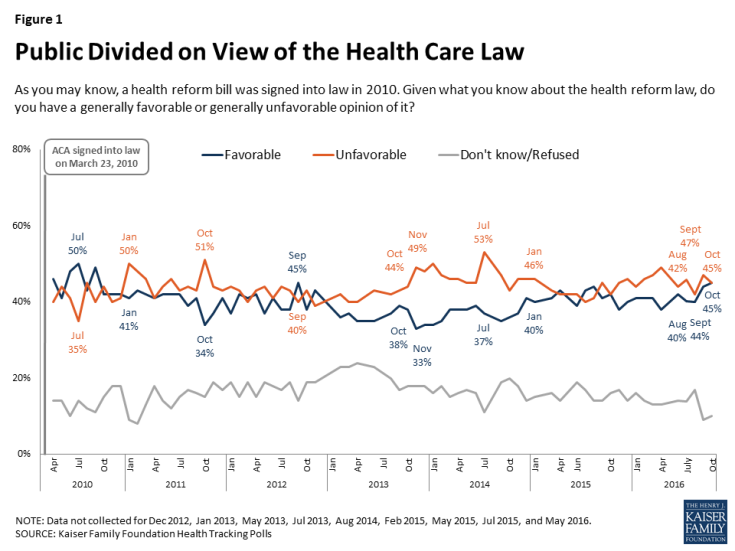
Public opinion on health reform is as frozen today as it was in spring, 2015

Kaiser monthly tracking polls show reliably unfavorable attitudes toward the ACA, slightly beating favorables, and stuck since 2014 in 40 percent purgatory. The advantages millions of Americans feel from ACA insurance coverage expansions and other access reforms are balanced by those who now blame the ACA for everything bad that happens in health care. The misnamed Pottery Barn rule—“if you break it, you own it”—applies here even though the dish was broken well before the ACA. Beyond this, if there is one thing on which both sides of the new Republican divide concur, it is a deep hostility towards ObamaCare. The election cycle seems to have only hardened these views.

kff-fav-unf


The essential differences between Democrats and Republicans are now more clear

We know more about the preferences of both parties with respect to the ACA than we did 18 months ago. Hillary Clinton, Donald Trump, and House Speaker Paul Ryan, have released health reform planks that clarify their intentions — regardless of Congressional feasibility.

Clinton wants to maintain and strengthen the ACA by improving premium affordability and by addressing excessive cost sharing in the Exchanges and beyond. She has an eight-point plan to address pharmaceutical prices. She will emphasize women’s health, and much more. Her campaign has articulated the first full agenda of any leading Democrat to improve and advance the ACA, helping to define the arena of possibility, whether far-fetched or not.

After early teasing about his admiration for the Canadian and Scottish single-payer systems, Trump embraced standard Republican orthodoxy on ObamaCare, most recently announcing his intention to call a special Congressional session as soon as possible to repeal the law. Two independent research institutes (Committee for a Responsible Federal Budget and the Commonwealth Fund) have concluded that Trump’s agenda, if implemented, would result in 20 million Americans losing health insurance and would increase the federal deficit by $330-550 billion over 10 years.

Meanwhile, Speaker Ryan announced in September his intention—if Republicans control both houses of Congress and the White House in January—to expedite budget reconciliation legislation that would repeal as much of ObamaCare as possible. Though Ryan’s plan is more ambitious than Trump’s, of the latter’s seven health policy planks, five also show up on the Speaker’s agenda.

The final week’s fireworks over premium increases in the individual health insurance market only emphasize that the political volatility of the ACA/ObamaCare has not diminished at all.

Differences involving the ACA are not about facts or data, but about fundamental values

One of my favorite political scientists, Deborah Stone, in her book Policy Paradox, writes that much of the policy process involves debates about values masquerading as debates about data and facts. That sure describes the past eight years of health reform. As my colleague Robert Blendon showed in his pre-election special report for The New England Journal of Medicine:

The political parties fundamentally differ over the role the federal government should play in intervening in the U.S. health care system, (and) the desirability of the federal government moving ahead with future efforts aimed at universal coverage…

blendonnejm

Source: POLITICO, Harvard T.H. Chan School of Public Health Poll. Voters and health care in the 2016 election. September 14–21, 2016.

The notion that these differences might be leavened, for example, by changing the age-rating bands (the maximum amount an insurer can charge in premiums for young people versus older enrollees) in the Exchanges from three-to-one up to six-to-one, is delusional. Six and a half years after its signing, the ACA has yet to become settled policy because the differences are simply too deep and neither side of the political divide can risk the backlash of surrender.

Republicans don’t want to fix the ACA car at any cost; they are determined to smash it

The excessively high premium increases in 2017 in the ACA Exchanges, more than anything, are tied to elimination in 2017 of risk corridors and reinsurance, as well as the undermining of risk adjustment. This past summer, Alaska’s Republican Legislature established its own reinsurance mechanism to stabilize rates, and immediately saw premium increases drop from over 40 percent to under 10 percent.

In my time as a member of the Massachusetts House of Representatives (1985-1997), I learned that when political partners like and respect each other, the most difficult challenges could be met with seeming ease; and conversely, when parties disliked and disrespected each other, the easiest chores were impossible to achieve. And thus it is with the ACA Exchanges, eminently fixable technically, and utterly unfixable politically.

And ACA demolition is advanced with no clearly defined replacement alternative. Yes, Speaker Ryan advanced a health reform agenda this past summer; yet he and his team did not put their ideas into legislative language that could be scored by the Congressional Budget Office, perhaps because they knew that the results on both lost insurance coverage and rising costs would turn the public against them.

“The future, like everything else, is no longer quite what it used to be.” (Paul Valery, 1937, not Yogi Berra).

As I write this on November 3rd, the most likely outcome from November 8 is divided government, with a Senate majority hanging by a thread. (Please recall that Senator Al Franken (D-MN) took his U.S. Senate seat for the first time in July 2009 after an eight-month recount process.) Republicans know that the electoral map in 2018, all things being equal, will offer substantial gains in both the Senate and the House, particularly if their political base is pleased. Democrats know that they will need to deliver on at least some of their promises, and not allow the signal accomplishment of the Obama Administration to fall apart.

Dare I say it: we’re going to need some statesmanship at a time when that commodity is in short supply.

The Choices on Health Reform in the US Presidential and Congressional Elections

The commentary below was published in JAMA Internal Medicine online on October 10 2016 and was written by me and David K. Jones from the Boston University School of Public Health:

Although the outcomes of the US Presidential and Congressional elections in November 2016 will not be determined by attitudes toward the Affordable Care Act (ACA), the results will likely determine its long-term fate. As was the case in 2008 and 2012, the electorate’s decisions on whether the Republicans or the Democrats control the White House, the Senate, and the House of Representatives will have fundamental consequences for the future of national health reform.

A Republican victory that includes that party’s control of the White House, Senate, and House of Representatives would likely augur huge shifts in national health policy. A Democratic victory that included the White House and a Senate majority would likely further embed the ACA into state and federal health policy, and perhaps lead to further expansion and reforms. More than 6 years after President Barack Obama signed the legislation into law in 2010, the ACA has yet to become settled policy.

The Republican Agenda

Over the past 4 years, Republican members of Congress and conservative think tanks such as the American Enterprise Institute and the Manhattan Institute have advanced numerous proposals to repeal and replace the ACA. As the final stages of the 2016 campaign approach, 2 plans stand out: Republican presidential candidate Donald Trump’s agenda as outlined on his campaign website,1 and the House Republican leadership plan released by Speaker Paul Ryan (R-WI) in June 2016.2 Continue reading “The Choices on Health Reform in the US Presidential and Congressional Elections”

How Might Democrats Try to Expand and Improve the ACA in 2017?

[Below is a new commentary just released by the Milbank Quarterly on their website — to be published in their fall edition.]

In 2017, if Democrats hold the White House and recapture a majority in the US Senate (control of the US House is considered unachievable), how might they try to change the Affordable Care Act (ACA)?

Despite congressional gridlock, changes to the ACA have happened. Six years since its enactment, the ACA has been altered 24 times by Congress and the president, mostly in response to Republican demands that generated some support from Democratic lawmakers as in the 2013 wholesale repeal of the ACA’s Title VIII, a new disability cash assistance program known as Community Living Assistance Services and Supports (CLASS—RIP).1

While Democrats and progressive groups have wish lists for ACA improvements, they have kept these low-key, prioritizing instead the need to repel repeated existential threats to the law, such as the 2 anti-ACA lawsuits that reached the US Supreme Court in 2012 and 2015 (National Federation of Independent Business v Sebelius and King v Burwell, respectively). Continue reading “How Might Democrats Try to Expand and Improve the ACA in 2017?”

Obama, Clinton and the New Public Option

The era of Democratic silence on strengthening and improving the Affordable Care Act is officially over.  President Barack Obama’s tour de force review of the ACA’s successes in the new Journal of the American Medical Association is also important for his identification of key ACA improvements needed on insurance affordability, Medicaid, prescription drug prices and more. I note his call for a “public option” health plan to spur competition in states with low numbers of health insurers participating in state ACA exchanges/marketplaces:

“…(I)n the original debate over health reform, Congress considered and I supported including a Medicare-like public plan. … Now, based on experience with the ACA, I think Congress should revisit a public plan to compete alongside private insurers in areas of the country where competition is limited. Adding a public plan in such areas would strengthen the Marketplace approach, giving consumers more affordable options while also creating savings for the federal government.”

Serendipitously, Sect. Hillary Clinton is now actively promoting the public option in her White House run, partially to woo backers of her Democratic opponent, Sen. Bernie Sanders (D-VT), and also because she has supported this idea since 2008:

“To make immediate progress toward that goal, Hillary will work with interested governors, using current flexibility under the Affordable Care Act, to empower states to establish a public option choice.”

What does the “public option” mean and why now? Continue reading “Obama, Clinton and the New Public Option”

House GOP ACA Replacement Plan Is an Empty Backpack

This week, US House Speaker Paul Ryan released a long-promised plan to replace the Affordable Care Act. Most of the plan, “A Better Way: Health Care,” developed by a House task force, includes familiar ideas that have been in Republican rhetoric even prior to the ACA. Coverage of the plan’s basics can be found here and here and here. Is there anything new, important, or revealing in this? Yes. Here is my list:

First, Team Ryan does not want you to know the cost or coverage impact of their proposal. Team Ryan is plenty capable of producing a legislative draft that could be scored by the backpack2Congressional Budget Office, and chose not to do so because that would be telling. Indeed. The ACA repeal legislation they sent to President Obama’s desk (subsequently vetoed) this past January would have eliminated health insurance for 22 million Americans who got it via the ACA. Is this new plan better? Team Ryan doesn’t want you to know.

Second, Team Ryan wants to eliminate income-based subsidies in favor of a flat tax credit. The most important reason people lack health insurance is because they don’t have enough income to afford it. The ACA’s structure is based on income – the most assistance goes to those with the least means, ending at 4 times the federal poverty level, or $97,200 for a household of four. Team Ryan offers a flat tax credit for anyone who can’t get employer coverage that would leave most people under 300% unable to afford coverage. How many? It’s impossible to say because Team Ryan doesn’t indicate the size of the credit. Continue reading “House GOP ACA Replacement Plan Is an Empty Backpack”

Back to the Future with Speaker Paul Ryan

This past week at Georgetown University, House Speaker Paul Ryan proposed scrapping an essential component of the Affordable Care Act (ACA) that bans health insurance companies from imposing pre-existing condition exclusions on consumers and prohibits the practice of “medical underwriting” to discriminate against anyone with a current or prior medical condition. Instead, he proposed, states could re-establish “high risk pools” from which those with pre-existing conditions could obtain coverage, leaving standard health insurance only for the “healthy.”

Paul Ryan 2Christopher Lloyd

Wow. Ryan may or may not realize it – but his speech just changed the stakes regarding the ACA and the November 8 federal elections.

Prior to Ryan’s speech, conventional wisdom, as evidenced in Republican Congressional and conservative think tank proposals, was to preserve the ACA’s ban on pre-existing conditions, albeit only for those who maintain “continuous coverage.” This stance enabled Republican office-holders to affirm their support for the pre-ex ban, even as their proposals’ fine print would reintroduce medical underwriting. Continue reading “Back to the Future with Speaker Paul Ryan”

Behind the Bipartisan Kumbaya on Substance Abuse

[This op-ed was posted yesterday on the website of the Milbank Quarterly.] 

For several years, Republicans and Democrats alike have been concerned about the crisis of opioid and heroin addiction in the United States. It is hard to find anyone who rejects the notion of a serious problem that demands at least a partial governmental response. Across the nation, governors and legislatures are hard at work seeking solutions and avoiding partisan bickering. Numerous current and former presidential candidates in the 2016 campaign cycle got favorable attention explaining how the crisis has affected their families and friends in personal ways.

Behavioral health

The question is whether there is any meaningful difference between Republicans and Democrats when it comes to substance abuse (and, for that matter, behavioral health—the merger of substance abuse and mental health).

The answer is yes, and the difference comes down to the Affordable Care Act (ACA). Continue reading “Behind the Bipartisan Kumbaya on Substance Abuse”

Trump’s Health Plan = 21 Million Uninsured, $270-500 Billion Budget Hole

On March 14, the Committee for a Responsible Federal Budget (CRFB), a bipartisan federal budget watchdog group, released an economic analysis of the recent health proposals made by Republican Presidential candidate Donald Trump.  Their key findings:

“Donald Trump’s plan to repeal and replace Obamacare would cost nearly $500 billion over a decade, or $270 billion incorporating economic growth.

“The plan would nearly double the number of uninsured, causing almost 21 million people to lose coverage.”

To my knowledge, this is the first serious and independent economic analysis of any Republican or conservative health reform plan released since the Affordable Care Act (ACA) was signed in 2010.  It’s not a pretty picture.

UninsuredDoubleUnderTrump

In addition to “completely repeal(ing) Obamacare,” Trump’s proposal would:

  • Allow sale of health insurance across state lines;
  • Allow individuals to fully deduct health insurance premiums from their income tax obligations;
  • Allow individuals to use Health Savings Accounts;
  • Require transparency from all health care providers;
  • Block grant Medicaid to the states;
  • Remove barriers to entry into free markets for drug providers.

Continue reading “Trump’s Health Plan = 21 Million Uninsured, $270-500 Billion Budget Hole”