
Pre-Election Reflections on Health Reform in the 2016 Campaign

[This post appeared in the Health Affairs blog on November 7 2016.  Happy election day, everyone!]

We are nearing the grand finale of our long and disheartening election opera, one we dare not ignore because the outcomes matter so much. While the election results will not be determined by public reactions to the Affordable Care Act, the ACA’s fate will be mightily determined by Tuesday’s outcomes. What have we learned about our collective health future over the past 18 months and what might this mean for our health system’s future?

Public opinion on health reform is as frozen today as it was in spring, 2015

Kaiser monthly tracking polls show reliably unfavorable attitudes toward the ACA, slightly beating favorables, and stuck since 2014 in 40 percent purgatory. The advantages millions of Americans feel from ACA insurance coverage expansions and other access reforms are balanced by those who now blame the ACA for everything bad that happens in health care. The misnamed Pottery Barn rule—“if you break it, you own it”—applies here even though the dish was broken well before the ACA. Beyond this, if there is one thing on which both sides of the new Republican divide concur, it is a deep hostility towards ObamaCare. The election cycle seems to have only hardened these views.
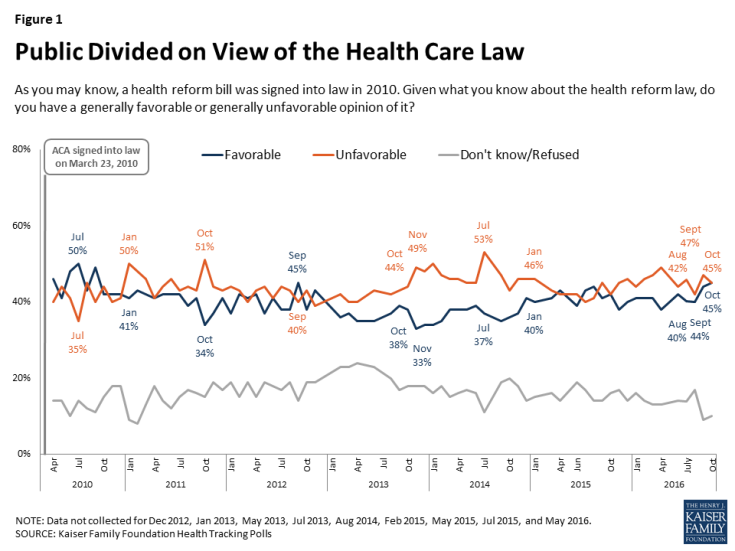
kff-fav-unf


The essential differences between Democrats and Republicans are now more clear

We know more about the preferences of both parties with respect to the ACA than we did 18 months ago. Hillary Clinton, Donald Trump, and House Speaker Paul Ryan, have released health reform planks that clarify their intentions — regardless of Congressional feasibility.

Clinton wants to maintain and strengthen the ACA by improving premium affordability and by addressing excessive cost sharing in the Exchanges and beyond. She has an eight-point plan to address pharmaceutical prices. She will emphasize women’s health, and much more. Her campaign has articulated the first full agenda of any leading Democrat to improve and advance the ACA, helping to define the arena of possibility, whether far-fetched or not.

After early teasing about his admiration for the Canadian and Scottish single-payer systems, Trump embraced standard Republican orthodoxy on ObamaCare, most recently announcing his intention to call a special Congressional session as soon as possible to repeal the law. Two independent research institutes (Committee for a Responsible Federal Budget and the Commonwealth Fund) have concluded that Trump’s agenda, if implemented, would result in 20 million Americans losing health insurance and would increase the federal deficit by $330-550 billion over 10 years.

Meanwhile, Speaker Ryan announced in September his intention—if Republicans control both houses of Congress and the White House in January—to expedite budget reconciliation legislation that would repeal as much of ObamaCare as possible. Though Ryan’s plan is more ambitious than Trump’s, of the latter’s seven health policy planks, five also show up on the Speaker’s agenda.

The final week’s fireworks over premium increases in the individual health insurance market only emphasize that the political volatility of the ACA/ObamaCare has not diminished at all.

Differences involving the ACA are not about facts or data, but about fundamental values

One of my favorite political scientists, Deborah Stone, in her book Policy Paradox, writes that much of the policy process involves debates about values masquerading as debates about data and facts. That sure describes the past eight years of health reform. As my colleague Robert Blendon showed in his pre-election special report for The New England Journal of Medicine:

The political parties fundamentally differ over the role the federal government should play in intervening in the U.S. health care system, (and) the desirability of the federal government moving ahead with future efforts aimed at universal coverage…

blendonnejm

Source: POLITICO, Harvard T.H. Chan School of Public Health Poll. Voters and health care in the 2016 election. September 14–21, 2016.

The notion that these differences might be leavened, for example, by changing the age-rating bands (the maximum amount an insurer can charge in premiums for young people versus older enrollees) in the Exchanges from three-to-one up to six-to-one, is delusional. Six and a half years after its signing, the ACA has yet to become settled policy because the differences are simply too deep and neither side of the political divide can risk the backlash of surrender.

Republicans don’t want to fix the ACA car at any cost; they are determined to smash it

The excessively high premium increases in 2017 in the ACA Exchanges, more than anything, are tied to elimination in 2017 of risk corridors and reinsurance, as well as the undermining of risk adjustment. This past summer, Alaska’s Republican Legislature established its own reinsurance mechanism to stabilize rates, and immediately saw premium increases drop from over 40 percent to under 10 percent.

In my time as a member of the Massachusetts House of Representatives (1985-1997), I learned that when political partners like and respect each other, the most difficult challenges could be met with seeming ease; and conversely, when parties disliked and disrespected each other, the easiest chores were impossible to achieve. And thus it is with the ACA Exchanges, eminently fixable technically, and utterly unfixable politically.

And ACA demolition is advanced with no clearly defined replacement alternative. Yes, Speaker Ryan advanced a health reform agenda this past summer; yet he and his team did not put their ideas into legislative language that could be scored by the Congressional Budget Office, perhaps because they knew that the results on both lost insurance coverage and rising costs would turn the public against them.

“The future, like everything else, is no longer quite what it used to be.” (Paul Valery, 1937, not Yogi Berra).

As I write this on November 3rd, the most likely outcome from November 8 is divided government, with a Senate majority hanging by a thread. (Please recall that Senator Al Franken (D-MN) took his U.S. Senate seat for the first time in July 2009 after an eight-month recount process.) Republicans know that the electoral map in 2018, all things being equal, will offer substantial gains in both the Senate and the House, particularly if their political base is pleased. Democrats know that they will need to deliver on at least some of their promises, and not allow the signal accomplishment of the Obama Administration to fall apart.

Dare I say it: we’re going to need some statesmanship at a time when that commodity is in short supply.

The Choices on Health Reform in the US Presidential and Congressional Elections

The commentary below was published in JAMA Internal Medicine online on October 10 2016 and was written by me and David K. Jones from the Boston University School of Public Health:

Although the outcomes of the US Presidential and Congressional elections in November 2016 will not be determined by attitudes toward the Affordable Care Act (ACA), the results will likely determine its long-term fate. As was the case in 2008 and 2012, the electorate’s decisions on whether the Republicans or the Democrats control the White House, the Senate, and the House of Representatives will have fundamental consequences for the future of national health reform.

A Republican victory that includes that party’s control of the White House, Senate, and House of Representatives would likely augur huge shifts in national health policy. A Democratic victory that included the White House and a Senate majority would likely further embed the ACA into state and federal health policy, and perhaps lead to further expansion and reforms. More than 6 years after President Barack Obama signed the legislation into law in 2010, the ACA has yet to become settled policy.

The Republican Agenda

Over the past 4 years, Republican members of Congress and conservative think tanks such as the American Enterprise Institute and the Manhattan Institute have advanced numerous proposals to repeal and replace the ACA. As the final stages of the 2016 campaign approach, 2 plans stand out: Republican presidential candidate Donald Trump’s agenda as outlined on his campaign website,1 and the House Republican leadership plan released by Speaker Paul Ryan (R-WI) in June 2016.2 Continue reading “The Choices on Health Reform in the US Presidential and Congressional Elections”

How Might Democrats Try to Expand and Improve the ACA in 2017?

[Below is a new commentary just released by the Milbank Quarterly on their website — to be published in their fall edition.]

In 2017, if Democrats hold the White House and recapture a majority in the US Senate (control of the US House is considered unachievable), how might they try to change the Affordable Care Act (ACA)?

Despite congressional gridlock, changes to the ACA have happened. Six years since its enactment, the ACA has been altered 24 times by Congress and the president, mostly in response to Republican demands that generated some support from Democratic lawmakers as in the 2013 wholesale repeal of the ACA’s Title VIII, a new disability cash assistance program known as Community Living Assistance Services and Supports (CLASS—RIP).1

While Democrats and progressive groups have wish lists for ACA improvements, they have kept these low-key, prioritizing instead the need to repel repeated existential threats to the law, such as the 2 anti-ACA lawsuits that reached the US Supreme Court in 2012 and 2015 (National Federation of Independent Business v Sebelius and King v Burwell, respectively). Continue reading “How Might Democrats Try to Expand and Improve the ACA in 2017?”

Obama, Clinton and the New Public Option

The era of Democratic silence on strengthening and improving the Affordable Care Act is officially over.  President Barack Obama’s tour de force review of the ACA’s successes in the new Journal of the American Medical Association is also important for his identification of key ACA improvements needed on insurance affordability, Medicaid, prescription drug prices and more. I note his call for a “public option” health plan to spur competition in states with low numbers of health insurers participating in state ACA exchanges/marketplaces:

“…(I)n the original debate over health reform, Congress considered and I supported including a Medicare-like public plan. … Now, based on experience with the ACA, I think Congress should revisit a public plan to compete alongside private insurers in areas of the country where competition is limited. Adding a public plan in such areas would strengthen the Marketplace approach, giving consumers more affordable options while also creating savings for the federal government.”

Serendipitously, Sect. Hillary Clinton is now actively promoting the public option in her White House run, partially to woo backers of her Democratic opponent, Sen. Bernie Sanders (D-VT), and also because she has supported this idea since 2008:

“To make immediate progress toward that goal, Hillary will work with interested governors, using current flexibility under the Affordable Care Act, to empower states to establish a public option choice.”

What does the “public option” mean and why now? Continue reading “Obama, Clinton and the New Public Option”

Back to the Future with Speaker Paul Ryan

This past week at Georgetown University, House Speaker Paul Ryan proposed scrapping an essential component of the Affordable Care Act (ACA) that bans health insurance companies from imposing pre-existing condition exclusions on consumers and prohibits the practice of “medical underwriting” to discriminate against anyone with a current or prior medical condition. Instead, he proposed, states could re-establish “high risk pools” from which those with pre-existing conditions could obtain coverage, leaving standard health insurance only for the “healthy.”

Paul Ryan 2Christopher Lloyd

Wow. Ryan may or may not realize it – but his speech just changed the stakes regarding the ACA and the November 8 federal elections.

Prior to Ryan’s speech, conventional wisdom, as evidenced in Republican Congressional and conservative think tank proposals, was to preserve the ACA’s ban on pre-existing conditions, albeit only for those who maintain “continuous coverage.” This stance enabled Republican office-holders to affirm their support for the pre-ex ban, even as their proposals’ fine print would reintroduce medical underwriting. Continue reading “Back to the Future with Speaker Paul Ryan”

Behind the Bipartisan Kumbaya on Substance Abuse

[This op-ed was posted yesterday on the website of the Milbank Quarterly.] 

For several years, Republicans and Democrats alike have been concerned about the crisis of opioid and heroin addiction in the United States. It is hard to find anyone who rejects the notion of a serious problem that demands at least a partial governmental response. Across the nation, governors and legislatures are hard at work seeking solutions and avoiding partisan bickering. Numerous current and former presidential candidates in the 2016 campaign cycle got favorable attention explaining how the crisis has affected their families and friends in personal ways.

Behavioral health

The question is whether there is any meaningful difference between Republicans and Democrats when it comes to substance abuse (and, for that matter, behavioral health—the merger of substance abuse and mental health).

The answer is yes, and the difference comes down to the Affordable Care Act (ACA). Continue reading “Behind the Bipartisan Kumbaya on Substance Abuse”

Trump’s Health Plan = 21 Million Uninsured, $270-500 Billion Budget Hole

On March 14, the Committee for a Responsible Federal Budget (CRFB), a bipartisan federal budget watchdog group, released an economic analysis of the recent health proposals made by Republican Presidential candidate Donald Trump.  Their key findings:

“Donald Trump’s plan to repeal and replace Obamacare would cost nearly $500 billion over a decade, or $270 billion incorporating economic growth.

“The plan would nearly double the number of uninsured, causing almost 21 million people to lose coverage.”

To my knowledge, this is the first serious and independent economic analysis of any Republican or conservative health reform plan released since the Affordable Care Act (ACA) was signed in 2010.  It’s not a pretty picture.

UninsuredDoubleUnderTrump

In addition to “completely repeal(ing) Obamacare,” Trump’s proposal would:

  • Allow sale of health insurance across state lines;
  • Allow individuals to fully deduct health insurance premiums from their income tax obligations;
  • Allow individuals to use Health Savings Accounts;
  • Require transparency from all health care providers;
  • Block grant Medicaid to the states;
  • Remove barriers to entry into free markets for drug providers.

Continue reading “Trump’s Health Plan = 21 Million Uninsured, $270-500 Billion Budget Hole”

Is the Fate of the ACA Settle or Not?

Below is an op-ed I wrote late last year for the Milbank Quarterly, published today.

Once upon a time, I believed that efforts to repeal the Affordable Care Act (ACA) would wither and die once the ACA’s major Medicaid and private insurance expansions became effective on January 1, 2014. After all, opponents had let Senator Ted Cruz (R-TX) trigger a 3-week federal government shutdown in October 2013 in a desperate final attempt to thwart the expansions. Over the course of 2 open enrollment periods, between 2013 and 2015, as many as 17 million previously uninsured Americans obtained coverage. Surely the worst was over. Now I am not so certain.

Since 2010, Americans have witnessed 3 near-death experiences relating to national health reform: first, the election of Scott Brown (R-MA) to the US Senate in January 2010, ending Democrats’ 60-vote filibuster-proof majority; second, the US Supreme Court’s decision in June 2012 upholding the constitutionality of the ACA writ large; and third, the November 6, 2012, federal elections in which a victory for presidential candidate Mitt Romney would have augured substantial repeal. By this standard, the October 2013 government shutdown and the 2015 Supreme Court case, King v Burwell, were faux near-death experiences, not the real thing. Continue reading “Is the Fate of the ACA Settle or Not?”

How Difficult Would It Be to Repeal Obamacare for Good?

A new website called “The Conversation” posted this article earlier today:

If the leading Republican candidates agree on one thing, it’s doing away with Obamacare.

“The one thing we have to do is repeal and replace Obamacare,” Donald Trump has written on his campaign website, while Marco Rubio has outlined his plan to “Repeal Obamacare” and “replace it with a 21st century, market-driven alternative.” Likewise, Senator Ted Cruz emphatically declared during the February 25 GOP debate that “As president, I will repeal every word of Obamacare.”

Is this the bombastic rhetoric of candidates trying to fire up their base? Or would Republicans actually be able to repeal Obamacare under a Republican president?

In short: yes, they could. But it wouldn’t be easy.

The main GOP obstacle

The essential requirement to achieve repeal is Republican control of the White House, the U.S. Senate and the House of Representatives in January 2017.

Unless both houses of Congress and the executive branch are under GOP control, Democrats would be able to block any repeal effort – and the Obamacare trench warfare that’s taken place since Democrats lost control of Congress in January 2011 would continue.

But even if Republicans control Congress and the White House, Senate Democrats could filibuster any legislation that repeals Obamacare.

Sixty senators must vote to close a filibuster – a Senate parliamentary tool designed to protect the rights of senators to slow or stall legislation and other matters. While, historically, filibusters took the form of long speeches on the Senate floor, these days it’s a less heroic procedural maneuver.

It’s unlikely that Republicans will have a 60-vote majority in the Senate in 2017. Meanwhile, Senate Democrats have been unanimous against repeal, and the number of Democrats in the chamber next year is predicted to increase over their current 46.

For this reason, even in if they’re in the minority, Democrats could block any straight repeal legislation and compel Republicans to resort to another path.

Skirting the filibuster with reconciliation

Republicans could then initiate an arcane legislative process called budget reconciliation. Invented in 1974 by the late West Virginia Senator Robert Byrd (arguably the shrewdest legislative tactician ever), budget reconciliation is a special legislative process that enables federal budget bills to be approved in an expedited fashion.

Reconciliation is the brainchild of West Virginia Senator Robert Byrd. Wikimedia Commons

The advantage of reconciliation is that it permits a bill to be approved by 51 votes. (If Republicans hold 50 votes in the new Senate – a possibility – a Republican vice president can provide the 51st vote.)

Since reconciliation bills cannot be filibustered, any Obamacare repeal bill done using reconciliation wouldn’t need a 60-vote majority to proceed. And debate on a reconciliation bill is limited to 20 hours. For a frustrated Senate that doesn’t have a 60-plus vote filibuster-proof majority, it’s the most potent legislative shortcut imaginable.

But there’s a vital catch: any item in a reconciliation bill must have a measurable, direct impact on federal spending, up or down.

The individual who decides what legislative items do and do not conform to this rule is the Senate parliamentarian – the individual tasked with advising Senate leaders on the interpretation of Senate rules. Appointed by the Senate majority leader whenever the prior parliamentarian steps down, a former Senate librarian clerk named Elizabeth MacDonough currently holds the position.

A full ACA repeal bill would be deemed noncompliant by MacDonough and set aside because so many of its individual provisions do not have a significant budget impact. In a process known as the “Byrd bath,” Senators can challenge any entire bill, section, subsection, paragraph, sentence or word as “out of order,” meaning there is no significant budget impact. Items eliminated by the parliamentarian – called “Byrd droppings” – are removed from the bill.

But could Republicans then devise a partial – and critically damaging – ACA repeal bill that might pass muster with MacDonough or her successor?

Yes, they can. In fact, they’ve already done so.

GOP shows it can be done

This past December and January, the Senate and the House passed a reconciliation bill that would have repealed fundamental building blocks of Obamacare, including subsidies to help moderate-income Americans afford health insurance and funds to expand Medicaid to low-income, uninsured individuals.

The Congressional Budget Office reviewed the proposal and determined that it would cancel insurance coverage for about 22 million Americans by 2018.

When the bill reached President Obama’s desk, he vetoed it. On February 2, Groundhog Day, the House failed to override his veto – their 63rd vote to repeal all or part of the ACA – voting almost completely along party lines.

Some observers declared that vote a waste of time because the outcome was known from the outset. This is erroneous.

A bill repealing crucial building blocks of Obamacare sits on a desk after being signed by U.S. House Speaker Paul Ryan on January 7, 2016. Jonathan Ernst/Reuters

Prior to the reconciliation bill passing the Senate this past December, many, including Senate Minority Leader Harry Reid, confidently predicted that Republicans would never successfully navigate the treacherous and confounding reconciliation waters.

But they did.

As a result, congressional Republicans have demonstrated that they can achieve effective deconstruction and de facto ACA repeal using reconciliation. It’s no longer an idle threat.

Every 2016 Republican presidential candidate has publicly declared his or her support for complete ACA repeal. Of the eight ACA replacement plans advanced by members of Congress and conservative think tanks, all but one presume total or near total repeal. And it’s difficult to identify more than a handful of Republican members who express any reservations about repeal.

So if there were a Republican president in Obama’s place, could a GOP-controlled Congress repeal the ACA early next year?

Maybe and maybe not.

A Senate majority in flux

It’s likely that Republicans will return to the Senate next January with fewer than their current 54 votes – and may even lose their majority.

That is because, in recent times, presidential election years have attracted more Democrats and liberals than midterm election years, which tend to result in more Republican, conservative leaning outcomes. Furthermore, Democrats have had notable success so far this cycle recruiting their top choices in key battleground states. Wisconsin Senator Russ Feingold is running for his old seat, while New Hampshire Governor Maggie Hassan now running against incumbent Republican Senator Kelly Ayotte.

Even more important, some Republicans appear to have supported January’s reconciliation bill precisely because they knew it would never become law.

One example is West Virginia Senator Shelley Moore Capito. Capito made it clear that she did not want to take Medicaid away from 160,000 low-income West Virginians. Other more moderate Republican senators – Maine’s Susan Collins, Illinois’ Mark Kirk, and New Hampshire’s Kelly Ayotte – might also think twice about voting to eliminate health coverage for vulnerable constituents for real.

Since President Obama signed the ACA in 2010, Republican Congressional leaders, especially House Speaker Paul Ryan, have cockily promised to move legislation to replace Obamacare.

It’s been six years of broken promises with their latest replacement show now underway. One reason for their inability is deep disagreement within the Republican conference about what could replace the ACA.

While Republicans find it easy to vote to repeal the law, their consensus vanishes when the topic turns to replacement. Look no further than the GOP debates, where candidates have been unable to articulate a consistent vision for health care policy beyond allowing the sale of health insurance across state lines and expanding high deductible health insurance policies.

So if Republicans capture the White House, Senate and House, will they repeal the ACA?

Maybe they can’t.

Continue reading “How Difficult Would It Be to Repeal Obamacare for Good?”

ACA’s Continuing Impact on Business

[This “sponsored content” article was published on bostonglobe.com on February 2nd.]

Six years after the Affordable Care Act (ACA) became law, U.S. health care policy and the delivery of medical services continue to undergo unprecedented change. Rockland Trust’s “Talking Business Advice Series” spoke with John E. McDonough, professor of Public Health Policy at the Harvard T.H. Chan School of Public Health, to get his take on what may lie ahead for businesses working with the ACA during this dynamic period.

Prof_McDonough_3

Q: You helped write the ACA. It’s an extremely complex law that even today is not fully understood by many Americans, including business owners and leaders. From a high-level perspective, where do things stand with it today?

A: Most people understand that the ACA is moving us toward universal health coverage. For the United States, the ACA is a revolution, an enormous set of changes that many see as a huge step forward and many others see as a wrong turn. Globally, however, all of the world’s advanced nations prior to the ACA already had health care schemes that, to varying degrees, met the insurance needs of their populations. So, while the ACA’s insurance expansions and reforms represent a great leap forward for the U.S., it is also true that when fully implemented by 2018, the U.S. will still have the most inefficient, wasteful, and unfair health insurance system of any advanced nation, even with the ACA reforms.

On the other hand, the ACA is also advancing an agenda of dramatic and necessary change in how medical care is delivered in the U.S. As a nation, we are now moving rapidly away from a financing system based on fee-for-service payments, (which is) a system that rewards hospitals, physicians, and other medical providers based on the quantity of services they provide without regard for the quality, effectiveness, and efficiency of those services. Because of the ACA, we are now moving quickly toward a new financing framework that rewards hospital, physicians, and providers based on the quality and value of the services they provide rather than the quantity.

Q: The public doesn’t necessarily view it in this way, does it?

A: You’re right. This change has gone unrecognized by the broad public, even as it moves forward in rapid and profound ways. A lot of what the ACA envisions is experimental. Some elements are working better than others; some continue to be fiercely debated. The U.S. doesn’t have all the answers in this effort, but we have the most dynamic set of experiments on this evolutionary path of any advanced nation on the planet right now. Health system leaders all around the world are very interested in this set of experiments and watching closely. That is something that corporate leaders, regardless of industry sector, ought to recognize, appreciate, and understand.

Q: What are some of the effects of these experiments on businesses?

shutterstock_267836885A: The immediate effects of the ACA depend on the context of the business itself. For example, the ACA’s impact is different for larger businesses with more than 50 full-time workers, companies with new responsibilities under the ACA’s employer mandate. It’s different for smaller employers and it provides some opportunities for many of them. It’s a unique new context for start-up businesses because of the health insurance marketplaces that provide new businesses with a new way to provide health insurance for their workers, enabling them to outsource their health coverage needs for themselves and their employees. And it enables all employees to get health care coverage regardless of pre-existing conditions, which was not possible in 45 states prior to the ACA.

So it’s contextual. It depends on the size and nature of the business as to whether there will be advantages or disadvantages—or both—to the Affordable Care Act.

Q: Would you expand on how smaller companies can outsource their health care responsibilities?

A: The ACA required the development of government-regulated health care exchanges (or marketplaces) across the nation. States had right of first refusal and 13 have chosen to establish their own exchanges while the rest are run by the U.S. Centers for Medicare and Medicaid Services (CMS). These exchanges offer coverage to all eligible individuals who can’t obtain insurance elsewhere, and many workers are eligible for financial subsidies to keep premiums and cost sharing affordable.

Alongside these public exchanges, new private health insurance exchanges have emerged. Unlike the public exchanges, which largely provide insurance to individuals seeking to buy non-group coverage, these private entities are aimed straight at the employer community. These private exchanges can enable employers to address their responsibilities under the ACA’s mandate to provide health insurance for their workers and do it in ways that are far less onerous for employers than in the past. It’s a way to outsource these responsibilities and to provide employees with a range of coverage choices. This is a significant change from the environment that existed prior to the ACA’s passage in 2010.

Q: How are larger businesses affected by the ACA?

A: Prior to the ACA’s passage, larger businesses were concerned about not being heavily shaped by the new law because most of these businesses already covered most of their employees. The impact of the ACA on larger businesses—especially those that self-insure—is far less than what they would experience in the standard commercial insurance market were they to go out and purchase traditional coverage.

Nonetheless, there are important new coverage requirements that impact the large employer market—whether self-insured or not. For example, lifetime or annual benefit limits on workers coverage is no longer permitted. Employer plans must cover the “essential health benefits” specified in the law. A worker’s insurance premium cannot exceed 9.5 percent of his or her household income or else the employer mandate penalty can be triggered. All employers must allow their workers to keep adult children on their family policies up to age 26. The ACA also sets a 90-day maximum waiting period before full-time workers are eligible for coverage.

There are also some elements of the law that many employers appreciate, including the ability to vary worker premiums by 30-50 percent in relation to workers’ use of tobacco products and participation in workplace wellness programs. Clinically proven preventive care services, such as mammography, must be provided to workers without any cost sharing.

The ACA’s impact is far more substantial in the traditional commercial health insurance market—but the impact on large self-insured employers is also meaningful.

Q: Are all the details of the ACA settled at this point?

A: This law is changing every day. There are at least three dozen things changing in relation to this law almost daily—in Congress, in federal agencies, in states, in the private sector—changes shaping how this law is unfolding across American society. And the pace of change hasn’t slowed, even now when we’re in the sixth year since the law was enacted.

857b31fa-2754-4722-91af-eb44dbc47690-acaThe ACA is likely to change even further next January when a new president and administration takes office, regardless of which party controls the White House and Congress. We can see an evolving agenda for changes from both sides of the political spectrum. Congressional Republicans have been united in their determination to dismantle the ACA for some time. In January, President Obama vetoed an attempt to cripple the ACA that was included in a budget reconciliation bill. The fact that this initiative passed Congress demonstrates that if Republicans control the White House, House, and Senate next January, there is a strong likelihood of significant dismantling of the law.

Conversely, if the Democrats hold the White House next year they also will have an agenda for significant changes to the ACA, though far less dramatic than what would happen under Republican control. Either way, we can anticipate some significant changes coming in 2017.

Q: How do business leaders prepare for that?

A: They need to keep abreast of whatever changes occur. Many organizations help businesses to stay on top of what’s changing or likely to change. It’s important for executives and managers who focus on a company’s health coverage to stay up-to-speed on what’s happening, and it’s important for those in the C-suite to understand the changes to factor these new variables into their strategic planning calculus.

As a nation, we are on a path of rapid and deep systemic change to our health system, and it’s going to unfold for some time to come. It is already transforming the fundamental nature of the U.S. medical care delivery system. The implications of it are vast and it will continue to unfold well into the future in positive, not-so-positive, and surprising ways.

It’s important for corporate executives to understand the nature of these changes as they happen.

The Harvard T.H. Chan School of Public Health will present a conference titled “Beyond the Affordable Care Act: The Next Frontiers for US Health Reform” on April 25-27. Visit https://ecpe.sph.harvard.edu/ for more information.