24 Million May Lose Health Insurance to Pay for Tax Cuts for Wealthy Americans

[This commentary, “GOP Cuts Are Moral Challenge for America,” was published on Commonwealth Magazine’s website on March 14.]

THE BIG NEWS IS, of course, Monday’s “score” from the Congressional Budget Office detailing that the House Republican bill to repeal and replace the Affordable Care Act/Obamacare will result in 14 million Americans losing health insurance by 2018 and 24 million by 2026.

Before that, something else caught my eye from the Bangor Daily News. It’s a blog post from a woman named Crystal Sands who writes about how the ACA enabled her and her young family to take a chance and find a new life as farmers. Her post, “The ACA makes a simpler farming life possible for our family,” says this:

“I’m a writer, an online professor, a farmer, a wife, and a mom. None of these jobs offer health insurance for me and my family, so our family purchases our health insurance through the Affordable Care Act. We work hard, but we try to work differently. If you read my blog, you know we’re learning to grow and raise our own food, and our health insurance through the ACA makes this possible.

“The ACA has helped me to become a better mom, a better wife, a better teacher because I am not so overworked, and it has made it so I can learn to be a farmer. I’m also just a better person. I’m not sick and overworked. I’m more patient and more kind and more helpful to everyone. And this is my story. There’s so much potential here to make lives better. There are many people, including many farmers, who depend on the ACA. I hope we don’t lose sight of that.

And now, CBO’s Cost Estimate of the American Health Care Act. Bottom line — $894 billion in tax cuts financed by $1.2 trillion in cuts to Medicaid and to subsidies/tax credits for private health insurance. Those cuts will produce an increase in numbers of uninsured Americans of 14 million by 2018, 21 million by 2020, and 24 million by 2026. Of the 24 million, 14 million will lose Medicaid and 10 million will lose private coverage, employer-sponsored and individual. Continue reading “24 Million May Lose Health Insurance to Pay for Tax Cuts for Wealthy Americans”

Vive la ACA Resistance!

[This commentary was published on the Commonwealth Magazine website last week.  If you are supportive of what the Affordable Care Act has achieved and want to help defend it — the time is NOW.  Please go to: http://protectmycare.org/ to learn how you can help, now. Everyone.  Please.]

A NEW REPUBLICAN-CONTROLLED Congress is in place. And for the sixth time, the Affordable Care Act (ACA) is facing extinction. Indeed, a gripping narrative history of the ACA/Obamacare could be written focused only on its numerous near-death experiences. Maybe the sixth time will be the curse, and maybe not. Let’s recall.

One, in January 2010, the loss of the 60th Democratic vote in the US Senate via the election of Republican Scott Brown to the seat formerly held by Massachusetts Sen. Edward Kennedy was almost universally assumed to be the end of the road for President Obama’s health reform agenda. He signed the ACA into law two months later.vive-la-resistance

Two, in June 2012, by a single vote, the US Supreme Court upheld the constitutionality of the ACA’s individual mandate and, by extension, the ACA. On the day of the decision, premature news accounts by CNN and Fox News erroneously reported that the court had overturned the law.

Three, in November 2012, thorough ACA repeal would have followed an electoral win by Republican Mitt Romney in that year’s presidential election, well before full implementation in 2014.

Four, between October-December 2013, catastrophic launches of the federal and state Health Exchange websites temporarily made the law a national laughingstock facing stillbirth at its most critical setup moment. The debacle was accompanied by a three-week October shutdown of the federal government in a final Republican spasm to prevent January 1, 2014, implementation.

Five, in June 2015, a second potentially fatal lawsuit that reached the US Supreme Court was laid aside by a 6-3 vote.

Six and lastly, the November 2016 federal elections represented the final life-threatening challenge.  An expected presidential victory by Democrat Hillary Clinton would have sealed the law’s lifespan at least until 2021. Instead, Republican Donald Trump’s victory now is leading many, once again, to predict the law’s effective demise this year.

Except, it ain’t necessarily so.  Here are three reasons why.

First, the Republicans’ ACA playbook is riddled with contradictions and dissent over their “repeal and delay” strategy.  Will delay last two, three, or four years? Once they repeal the law’s financing, how can they pay for even a minimal replacement? Will they do one replacement or a series of replacement bills? How can they keep private insurance companies from abandoning the individual insurance market in soon-to-be demolished health exchanges?  How will they keep preposterous promises that their still-unknown replacement will provide better coverage at lower cost for everyone who has been helped by the ACA? How will they keep Republican governors in line as they seek to slash Medicaid spending by approximately $1 trillion dollars over 10 years? These are just for starters.

For a devastating look at the contradictions in “repeal and delay,” see this week’s Health Affairs blog by conservative analysts Joseph Antos and James Capretta: “The Problems with ‘Repeal and Delay.’” “The most likely end result of ‘repeal and delay,’” they write, “would be less secure insurance for many Americans, procrastination by political leaders who will delay taking any proactive steps as long as possible, and ultimately no discernible movement toward a real marketplace for either insurance or medical services.”

Second, as Americans now focus on Republican non-plans and non-answers, public opinion is turning against them. Recent Kaiser Family Foundation polling shows that even Trump voters – who are far more chronically ill and needy than Clinton backers – support nearly all of the ACA’s essential building blocks except for the individual mandate, and oppose repeal without a replacement plan. As Noam Levey from the Los Angeles Times has shown, not a single nationally recognized patient or health care provider organization supports the Republican repeal agenda. Only the fringes of the Tea Party stand by their sides in this backward quest.

Third, while defenders of Republican drive to end coverage for between 22 to 30 million Americans are few and far between, broad resistance to the first major policy thrust of the Trump era is building.  A broad-based “Protect Your Care” coalition is spearheading national resistance, collaborating with President Obama and congressional Democrats and leading to a day of demonstrations across the nation on January 15. Hospitals, doctor and medical student groups, insurance companies, community health centers, and other health care stakeholders are making clear the damage now threatening the entire US health care system. Meanwhile, former Democratic congressional staffers have developed a blueprint for broad-based resistance to the Trump/Republican agenda, called “Indivisible.”

Republicans may win, though they will rue the day that they set in motion destabilization of the nation’s health care system. Around the globe, universal health coverage is now recognized not just as something governments do to be nice to their people, it is understood as an essential precondition for healthy societies and healthy economies. Over the past eight years, the United States has been moving forward to join the universal consensus of advanced nations, most of whom are far less affluent than the US.

Whether Republicans succeed or fail is not just up to them. It is now up to all Americans. Vive la ACA resistance!

Pre-Election Reflections on Health Reform in the 2016 Campaign

[This post appeared in the Health Affairs blog on November 7 2016.  Happy election day, everyone!]

We are nearing the grand finale of our long and disheartening election opera, one we dare not ignore because the outcomes matter so much. While the election results will not be determined by public reactions to the Affordable Care Act, the ACA’s fate will be mightily determined by Tuesday’s outcomes. What have we learned about our collective health future over the past 18 months and what might this mean for our health system’s future?

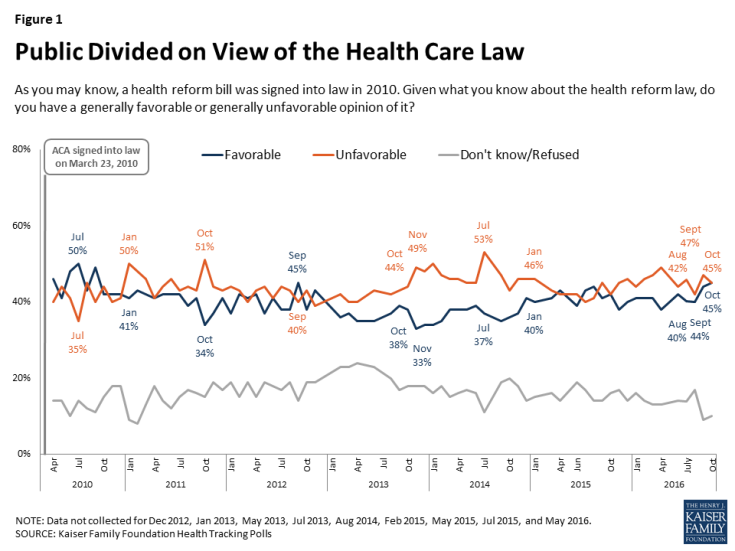
Public opinion on health reform is as frozen today as it was in spring, 2015

Kaiser monthly tracking polls show reliably unfavorable attitudes toward the ACA, slightly beating favorables, and stuck since 2014 in 40 percent purgatory. The advantages millions of Americans feel from ACA insurance coverage expansions and other access reforms are balanced by those who now blame the ACA for everything bad that happens in health care. The misnamed Pottery Barn rule—“if you break it, you own it”—applies here even though the dish was broken well before the ACA. Beyond this, if there is one thing on which both sides of the new Republican divide concur, it is a deep hostility towards ObamaCare. The election cycle seems to have only hardened these views.

kff-fav-unf


The essential differences between Democrats and Republicans are now more clear

We know more about the preferences of both parties with respect to the ACA than we did 18 months ago. Hillary Clinton, Donald Trump, and House Speaker Paul Ryan, have released health reform planks that clarify their intentions — regardless of Congressional feasibility.

Clinton wants to maintain and strengthen the ACA by improving premium affordability and by addressing excessive cost sharing in the Exchanges and beyond. She has an eight-point plan to address pharmaceutical prices. She will emphasize women’s health, and much more. Her campaign has articulated the first full agenda of any leading Democrat to improve and advance the ACA, helping to define the arena of possibility, whether far-fetched or not.

After early teasing about his admiration for the Canadian and Scottish single-payer systems, Trump embraced standard Republican orthodoxy on ObamaCare, most recently announcing his intention to call a special Congressional session as soon as possible to repeal the law. Two independent research institutes (Committee for a Responsible Federal Budget and the Commonwealth Fund) have concluded that Trump’s agenda, if implemented, would result in 20 million Americans losing health insurance and would increase the federal deficit by $330-550 billion over 10 years.

Meanwhile, Speaker Ryan announced in September his intention—if Republicans control both houses of Congress and the White House in January—to expedite budget reconciliation legislation that would repeal as much of ObamaCare as possible. Though Ryan’s plan is more ambitious than Trump’s, of the latter’s seven health policy planks, five also show up on the Speaker’s agenda.

The final week’s fireworks over premium increases in the individual health insurance market only emphasize that the political volatility of the ACA/ObamaCare has not diminished at all.

Differences involving the ACA are not about facts or data, but about fundamental values

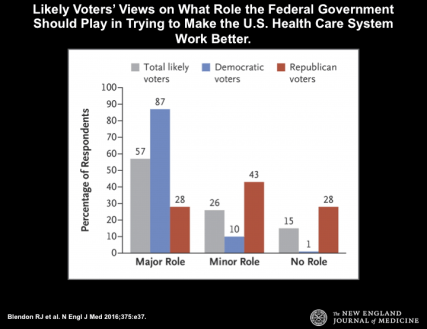
One of my favorite political scientists, Deborah Stone, in her book Policy Paradox, writes that much of the policy process involves debates about values masquerading as debates about data and facts. That sure describes the past eight years of health reform. As my colleague Robert Blendon showed in his pre-election special report for The New England Journal of Medicine:

The political parties fundamentally differ over the role the federal government should play in intervening in the U.S. health care system, (and) the desirability of the federal government moving ahead with future efforts aimed at universal coverage…
blendonnejm

Source: POLITICO, Harvard T.H. Chan School of Public Health Poll. Voters and health care in the 2016 election. September 14–21, 2016.

The notion that these differences might be leavened, for example, by changing the age-rating bands (the maximum amount an insurer can charge in premiums for young people versus older enrollees) in the Exchanges from three-to-one up to six-to-one, is delusional. Six and a half years after its signing, the ACA has yet to become settled policy because the differences are simply too deep and neither side of the political divide can risk the backlash of surrender.

Republicans don’t want to fix the ACA car at any cost; they are determined to smash it

The excessively high premium increases in 2017 in the ACA Exchanges, more than anything, are tied to elimination in 2017 of risk corridors and reinsurance, as well as the undermining of risk adjustment. This past summer, Alaska’s Republican Legislature established its own reinsurance mechanism to stabilize rates, and immediately saw premium increases drop from over 40 percent to under 10 percent.

In my time as a member of the Massachusetts House of Representatives (1985-1997), I learned that when political partners like and respect each other, the most difficult challenges could be met with seeming ease; and conversely, when parties disliked and disrespected each other, the easiest chores were impossible to achieve. And thus it is with the ACA Exchanges, eminently fixable technically, and utterly unfixable politically.

And ACA demolition is advanced with no clearly defined replacement alternative. Yes, Speaker Ryan advanced a health reform agenda this past summer; yet he and his team did not put their ideas into legislative language that could be scored by the Congressional Budget Office, perhaps because they knew that the results on both lost insurance coverage and rising costs would turn the public against them.

“The future, like everything else, is no longer quite what it used to be.” (Paul Valery, 1937, not Yogi Berra).

As I write this on November 3rd, the most likely outcome from November 8 is divided government, with a Senate majority hanging by a thread. (Please recall that Senator Al Franken (D-MN) took his U.S. Senate seat for the first time in July 2009 after an eight-month recount process.) Republicans know that the electoral map in 2018, all things being equal, will offer substantial gains in both the Senate and the House, particularly if their political base is pleased. Democrats know that they will need to deliver on at least some of their promises, and not allow the signal accomplishment of the Obama Administration to fall apart.

Dare I say it: we’re going to need some statesmanship at a time when that commodity is in short supply.

How Might Democrats Try to Expand and Improve the ACA in 2017?

[Below is a new commentary just released by the Milbank Quarterly on their website — to be published in their fall edition.]

In 2017, if Democrats hold the White House and recapture a majority in the US Senate (control of the US House is considered unachievable), how might they try to change the Affordable Care Act (ACA)?

Despite congressional gridlock, changes to the ACA have happened. Six years since its enactment, the ACA has been altered 24 times by Congress and the president, mostly in response to Republican demands that generated some support from Democratic lawmakers as in the 2013 wholesale repeal of the ACA’s Title VIII, a new disability cash assistance program known as Community Living Assistance Services and Supports (CLASS—RIP).1

While Democrats and progressive groups have wish lists for ACA improvements, they have kept these low-key, prioritizing instead the need to repel repeated existential threats to the law, such as the 2 anti-ACA lawsuits that reached the US Supreme Court in 2012 and 2015 (National Federation of Independent Business v Sebelius and King v Burwell, respectively). Continue reading “How Might Democrats Try to Expand and Improve the ACA in 2017?”

Obama, Clinton and the New Public Option

The era of Democratic silence on strengthening and improving the Affordable Care Act is officially over.  President Barack Obama’s tour de force review of the ACA’s successes in the new Journal of the American Medical Association is also important for his identification of key ACA improvements needed on insurance affordability, Medicaid, prescription drug prices and more. I note his call for a “public option” health plan to spur competition in states with low numbers of health insurers participating in state ACA exchanges/marketplaces:

“…(I)n the original debate over health reform, Congress considered and I supported including a Medicare-like public plan. … Now, based on experience with the ACA, I think Congress should revisit a public plan to compete alongside private insurers in areas of the country where competition is limited. Adding a public plan in such areas would strengthen the Marketplace approach, giving consumers more affordable options while also creating savings for the federal government.”

Serendipitously, Sect. Hillary Clinton is now actively promoting the public option in her White House run, partially to woo backers of her Democratic opponent, Sen. Bernie Sanders (D-VT), and also because she has supported this idea since 2008:

“To make immediate progress toward that goal, Hillary will work with interested governors, using current flexibility under the Affordable Care Act, to empower states to establish a public option choice.”

What does the “public option” mean and why now? Continue reading “Obama, Clinton and the New Public Option”

House GOP ACA Replacement Plan Is an Empty Backpack

This week, US House Speaker Paul Ryan released a long-promised plan to replace the Affordable Care Act. Most of the plan, “A Better Way: Health Care,” developed by a House task force, includes familiar ideas that have been in Republican rhetoric even prior to the ACA. Coverage of the plan’s basics can be found here and here and here. Is there anything new, important, or revealing in this? Yes. Here is my list:

First, Team Ryan does not want you to know the cost or coverage impact of their proposal. Team Ryan is plenty capable of producing a legislative draft that could be scored by the backpack2Congressional Budget Office, and chose not to do so because that would be telling. Indeed. The ACA repeal legislation they sent to President Obama’s desk (subsequently vetoed) this past January would have eliminated health insurance for 22 million Americans who got it via the ACA. Is this new plan better? Team Ryan doesn’t want you to know.

Second, Team Ryan wants to eliminate income-based subsidies in favor of a flat tax credit. The most important reason people lack health insurance is because they don’t have enough income to afford it. The ACA’s structure is based on income – the most assistance goes to those with the least means, ending at 4 times the federal poverty level, or $97,200 for a household of four. Team Ryan offers a flat tax credit for anyone who can’t get employer coverage that would leave most people under 300% unable to afford coverage. How many? It’s impossible to say because Team Ryan doesn’t indicate the size of the credit. Continue reading “House GOP ACA Replacement Plan Is an Empty Backpack”

Back to the Future with Speaker Paul Ryan

This past week at Georgetown University, House Speaker Paul Ryan proposed scrapping an essential component of the Affordable Care Act (ACA) that bans health insurance companies from imposing pre-existing condition exclusions on consumers and prohibits the practice of “medical underwriting” to discriminate against anyone with a current or prior medical condition. Instead, he proposed, states could re-establish “high risk pools” from which those with pre-existing conditions could obtain coverage, leaving standard health insurance only for the “healthy.”

Paul Ryan 2Christopher Lloyd

Wow. Ryan may or may not realize it – but his speech just changed the stakes regarding the ACA and the November 8 federal elections.

Prior to Ryan’s speech, conventional wisdom, as evidenced in Republican Congressional and conservative think tank proposals, was to preserve the ACA’s ban on pre-existing conditions, albeit only for those who maintain “continuous coverage.” This stance enabled Republican office-holders to affirm their support for the pre-ex ban, even as their proposals’ fine print would reintroduce medical underwriting. Continue reading “Back to the Future with Speaker Paul Ryan”

Behind the Bipartisan Kumbaya on Substance Abuse

[This op-ed was posted yesterday on the website of the Milbank Quarterly.] 

For several years, Republicans and Democrats alike have been concerned about the crisis of opioid and heroin addiction in the United States. It is hard to find anyone who rejects the notion of a serious problem that demands at least a partial governmental response. Across the nation, governors and legislatures are hard at work seeking solutions and avoiding partisan bickering. Numerous current and former presidential candidates in the 2016 campaign cycle got favorable attention explaining how the crisis has affected their families and friends in personal ways.

Behavioral health

The question is whether there is any meaningful difference between Republicans and Democrats when it comes to substance abuse (and, for that matter, behavioral health—the merger of substance abuse and mental health).

The answer is yes, and the difference comes down to the Affordable Care Act (ACA). Continue reading “Behind the Bipartisan Kumbaya on Substance Abuse”

Behind the Turnaround at the MA Health Connector

(This article was just published in the Spring Issue of Commonwealth magazine.)

It’s 11:59 PM on October 31, 2015, about 20 nervous state officials and contractors hunched around computer terminals in a non-descript office in the Charles F. Hurley Building near Beacon Hill. Among them was Louis Gutierrez, executive director of the Massachusetts Health Connector, appointed the previous February by newly inaugurated Gov. Charlie Baker. The launch of the third open enrollment since the 2013 implementation of the federal Affordable Care Act (ACA) was less than a minute away with lots on the line. Would months of hard preparation avoid another website calamity that could jeopardize health insurance for hundreds of thousands of Massachusetts residents.

As the website opened at midnight and kept humming without a hitch throughout the night and following days, sighs of relief were heard across the Commonwealth as a major governmental embarrassment was averted. By early February 2016, 201,000 state

Guttierez
Louis Gutierrez

residents had successfully enrolled in plans for 2016, including 36,000 new members. Today, the Connector is a marquee success for the still-youngish Baker administration — an ironic twist for a Republican governor who was never a fan of the ACA, Barack Obama’s marquee presidential achievement. Continue reading “Behind the Turnaround at the MA Health Connector”

Trump’s Health Plan = 21 Million Uninsured, $270-500 Billion Budget Hole

On March 14, the Committee for a Responsible Federal Budget (CRFB), a bipartisan federal budget watchdog group, released an economic analysis of the recent health proposals made by Republican Presidential candidate Donald Trump.  Their key findings:

“Donald Trump’s plan to repeal and replace Obamacare would cost nearly $500 billion over a decade, or $270 billion incorporating economic growth.

“The plan would nearly double the number of uninsured, causing almost 21 million people to lose coverage.”

To my knowledge, this is the first serious and independent economic analysis of any Republican or conservative health reform plan released since the Affordable Care Act (ACA) was signed in 2010.  It’s not a pretty picture.

UninsuredDoubleUnderTrump

In addition to “completely repeal(ing) Obamacare,” Trump’s proposal would:

  • Allow sale of health insurance across state lines;
  • Allow individuals to fully deduct health insurance premiums from their income tax obligations;
  • Allow individuals to use Health Savings Accounts;
  • Require transparency from all health care providers;
  • Block grant Medicaid to the states;
  • Remove barriers to entry into free markets for drug providers.

Continue reading “Trump’s Health Plan = 21 Million Uninsured, $270-500 Billion Budget Hole”