[Below is a new commentary just released by the Milbank Quarterly on their website — to be published in their fall edition.]
In 2017, if Democrats hold the White House and recapture a majority in the US Senate (control of the US House is considered unachievable), how might they try to change the Affordable Care Act (ACA)?
Despite congressional gridlock, changes to the ACA have happened. Six years since its enactment, the ACA has been altered 24 times by Congress and the president, mostly in response to Republican demands that generated some support from Democratic lawmakers as in the 2013 wholesale repeal of the ACA’s Title VIII, a new disability cash assistance program known as Community Living Assistance Services and Supports (CLASS—RIP).1
While Democrats and progressive groups have wish lists for ACA improvements, they have kept these low-key, prioritizing instead the need to repel repeated existential threats to the law, such as the 2 anti-ACA lawsuits that reached the US Supreme Court in 2012 and 2015 (National Federation of Independent Business v Sebelius and King v Burwell, respectively). Continue reading “How Might Democrats Try to Expand and Improve the ACA in 2017?”
The era of Democratic silence on strengthening and improving the Affordable Care Act is officially over. President Barack Obama’s tour de force review of the ACA’s successes in the new Journal of the American Medical Association is also important for his identification of key ACA improvements needed on insurance affordability, Medicaid, prescription drug prices and more. I note his call for a “public option” health plan to spur competition in states with low numbers of health insurers participating in state ACA exchanges/marketplaces:
“…(I)n the original debate over health reform, Congress considered and I supported including a Medicare-like public plan. … Now, based on experience with the ACA, I think Congress should revisit a public plan to compete alongside private insurers in areas of the country where competition is limited. Adding a public plan in such areas would strengthen the Marketplace approach, giving consumers more affordable options while also creating savings for the federal government.”
Serendipitously, Sect. Hillary Clinton is now actively promoting the public option in her White House run, partially to woo backers of her Democratic opponent, Sen. Bernie Sanders (D-VT), and also because she has supported this idea since 2008:
“To make immediate progress toward that goal, Hillary will work with interested governors, using current flexibility under the Affordable Care Act, to empower states to establish a public option choice.”
This week, US House Speaker Paul Ryan released a long-promised plan to replace the Affordable Care Act. Most of the plan, “A Better Way: Health Care,” developed by a House task force, includes familiar ideas that have been in Republican rhetoric even prior to the ACA. Coverage of the plan’s basics can be found here and here and here. Is there anything new, important, or revealing in this? Yes. Here is my list:
First, Team Ryan does not want you to know the cost or coverage impact of their proposal. Team Ryan is plenty capable of producing a legislative draft that could be scored by the Congressional Budget Office, and chose not to do so because that would be telling. Indeed. The ACA repeal legislation they sent to President Obama’s desk (subsequently vetoed) this past January would have eliminated health insurance for 22 million Americans who got it via the ACA. Is this new plan better? Team Ryan doesn’t want you to know.
Second, Team Ryan wants to eliminate income-based subsidies in favor of a flat tax credit. The most important reason people lack health insurance is because they don’t have enough income to afford it. The ACA’s structure is based on income – the most assistance goes to those with the least means, ending at 4 times the federal poverty level, or $97,200 for a household of four. Team Ryan offers a flat tax credit for anyone who can’t get employer coverage that would leave most people under 300% unable to afford coverage. How many? It’s impossible to say because Team Ryan doesn’t indicate the size of the credit. Continue reading “House GOP ACA Replacement Plan Is an Empty Backpack”
This past week at Georgetown University, House Speaker Paul Ryan proposed scrapping an essential component of the Affordable Care Act (ACA) that bans health insurance companies from imposing pre-existing condition exclusions on consumers and prohibits the practice of “medical underwriting” to discriminate against anyone with a current or prior medical condition. Instead, he proposed, states could re-establish “high risk pools” from which those with pre-existing conditions could obtain coverage, leaving standard health insurance only for the “healthy.”
Wow. Ryan may or may not realize it – but his speech just changed the stakes regarding the ACA and the November 8 federal elections.
For several years, Republicans and Democrats alike have been concerned about the crisis of opioid and heroin addiction in the United States. It is hard to find anyone who rejects the notion of a serious problem that demands at least a partial governmental response. Across the nation, governors and legislatures are hard at work seeking solutions and avoiding partisan bickering. Numerous current and former presidential candidates in the 2016 campaign cycle got favorable attention explaining how the crisis has affected their families and friends in personal ways.
The question is whether there is any meaningful difference between Republicans and Democrats when it comes to substance abuse (and, for that matter, behavioral health—the merger of substance abuse and mental health).
It’s 11:59 PM on October 31, 2015, about 20 nervous state officials and contractors hunched around computer terminals in a non-descript office in the Charles F. Hurley Building near Beacon Hill. Among them was Louis Gutierrez, executive director of the Massachusetts Health Connector, appointed the previous February by newly inaugurated Gov. Charlie Baker. The launch of the third open enrollment since the 2013 implementation of the federal Affordable Care Act (ACA) was less than a minute away with lots on the line. Would months of hard preparation avoid another website calamity that could jeopardize health insurance for hundreds of thousands of Massachusetts residents.
As the website opened at midnight and kept humming without a hitch throughout the night and following days, sighs of relief were heard across the Commonwealth as a major governmental embarrassment was averted. By early February 2016, 201,000 state
Louis Gutierrez
residents had successfully enrolled in plans for 2016, including 36,000 new members. Today, the Connector is a marquee success for the still-youngish Baker administration — an ironic twist for a Republican governor who was never a fan of the ACA, Barack Obama’s marquee presidential achievement. Continue reading “Behind the Turnaround at the MA Health Connector”
“Donald Trump’s plan to repeal and replace Obamacare would cost nearly $500 billion over a decade, or $270 billion incorporating economic growth.
“The plan would nearly double the number of uninsured, causing almost 21 million people to lose coverage.”
To my knowledge, this is the first serious and independent economic analysis of any Republican or conservative health reform plan released since the Affordable Care Act (ACA) was signed in 2010. It’s not a pretty picture.
In addition to “completely repeal(ing) Obamacare,” Trump’s proposal would:
Allow sale of health insurance across state lines;
Allow individuals to fully deduct health insurance premiums from their income tax obligations;
Allow individuals to use Health Savings Accounts;
Require transparency from all health care providers;
Block grant Medicaid to the states;
Remove barriers to entry into free markets for drug providers.
Once upon a time, I believed that efforts to repeal the Affordable Care Act (ACA) would wither and die once the ACA’s major Medicaid and private insurance expansions became effective on January 1, 2014. After all, opponents had let Senator Ted Cruz (R-TX) trigger a 3-week federal government shutdown in October 2013 in a desperate final attempt to thwart the expansions. Over the course of 2 open enrollment periods, between 2013 and 2015, as many as 17 million previously uninsured Americans obtained coverage. Surely the worst was over. Now I am not so certain.
Since 2010, Americans have witnessed 3 near-death experiences relating to national health reform: first, the election of Scott Brown (R-MA) to the US Senate in January 2010, ending Democrats’ 60-vote filibuster-proof majority; second, the US Supreme Court’s decision in June 2012 upholding the constitutionality of the ACA writ large; and third, the November 6, 2012, federal elections in which a victory for presidential candidate Mitt Romney would have augured substantial repeal. By this standard, the October 2013 government shutdown and the 2015 Supreme Court case, King v Burwell, were faux near-death experiences, not the real thing. Continue reading “Is the Fate of the ACA Settle or Not?”
A new website called “The Conversation” posted this article earlier today:
If the leading Republican candidates agree on one thing, it’s doing away with Obamacare.
“The one thing we have to do is repeal and replace Obamacare,” Donald Trump has written on his campaign website, while Marco Rubio has outlined his plan to “Repeal Obamacare” and “replace it with a 21st century, market-driven alternative.” Likewise, Senator Ted Cruz emphatically declared during the February 25 GOP debate that “As president, I will repeal every word of Obamacare.”
Is this the bombastic rhetoric of candidates trying to fire up their base? Or would Republicans actually be able to repeal Obamacare under a Republican president?
In short: yes, they could. But it wouldn’t be easy.
The main GOP obstacle
The essential requirement to achieve repeal is Republican control of the White House, the U.S. Senate and the House of Representatives in January 2017.
Unless both houses of Congress and the executive branch are under GOP control, Democrats would be able to block any repeal effort – and the Obamacare trench warfare that’s taken place since Democrats lost control of Congress in January 2011 would continue.
But even if Republicans control Congress and the White House, Senate Democrats could filibuster any legislation that repeals Obamacare.
Sixty senators must vote to close a filibuster – a Senate parliamentary tool designed to protect the rights of senators to slow or stall legislation and other matters. While, historically, filibusters took the form of long speeches on the Senate floor, these days it’s a less heroic procedural maneuver.
It’s unlikely that Republicans will have a 60-vote majority in the Senate in 2017. Meanwhile, Senate Democrats have been unanimous against repeal, and the number of Democrats in the chamber next year is predicted to increase over their current 46.
For this reason, even in if they’re in the minority, Democrats could block any straight repeal legislation and compel Republicans to resort to another path.
Skirting the filibuster with reconciliation
Republicans could then initiate an arcane legislative process called budget reconciliation. Invented in 1974 by the late West Virginia Senator Robert Byrd (arguably the shrewdest legislative tactician ever), budget reconciliation is a special legislative process that enables federal budget bills to be approved in an expedited fashion.
Reconciliation is the brainchild of West Virginia Senator Robert Byrd.Wikimedia Commons
The advantage of reconciliation is that it permits a bill to be approved by 51 votes. (If Republicans hold 50 votes in the new Senate – a possibility – a Republican vice president can provide the 51st vote.)
Since reconciliation bills cannot be filibustered, any Obamacare repeal bill done using reconciliation wouldn’t need a 60-vote majority to proceed. And debate on a reconciliation bill is limited to 20 hours. For a frustrated Senate that doesn’t have a 60-plus vote filibuster-proof majority, it’s the most potent legislative shortcut imaginable.
But there’s a vital catch: any item in a reconciliation bill must have a measurable, direct impact on federal spending, up or down.
The individual who decides what legislative items do and do not conform to this rule is the Senate parliamentarian – the individual tasked with advising Senate leaders on the interpretation of Senate rules. Appointed by the Senate majority leader whenever the prior parliamentarian steps down, a former Senate librarian clerk named Elizabeth MacDonough currently holds the position.
A full ACA repeal bill would be deemed noncompliant by MacDonough and set aside because so many of its individual provisions do not have a significant budget impact. In a process known as the “Byrd bath,” Senators can challenge any entire bill, section, subsection, paragraph, sentence or word as “out of order,” meaning there is no significant budget impact. Items eliminated by the parliamentarian – called “Byrd droppings” – are removed from the bill.
But could Republicans then devise a partial – and critically damaging – ACA repeal bill that might pass muster with MacDonough or her successor?
Yes, they can. In fact, they’ve already done so.
GOP shows it can be done
This past December and January, the Senate and the House passed a reconciliation bill that would have repealed fundamental building blocks of Obamacare, including subsidies to help moderate-income Americans afford health insurance and funds to expand Medicaid to low-income, uninsured individuals.
The Congressional Budget Office reviewed the proposal and determined that it would cancel insurance coverage for about 22 million Americans by 2018.
When the bill reached President Obama’s desk, he vetoed it. On February 2, Groundhog Day, the House failed to override his veto – their 63rd vote to repeal all or part of the ACA – voting almost completely along party lines.
Some observers declared that vote a waste of time because the outcome was known from the outset. This is erroneous.
A bill repealing crucial building blocks of Obamacare sits on a desk after being signed by U.S. House Speaker Paul Ryan on January 7, 2016.Jonathan Ernst/Reuters
Prior to the reconciliation bill passing the Senate this past December, many, including Senate Minority Leader Harry Reid, confidently predicted that Republicans would never successfully navigate the treacherous and confounding reconciliation waters.
But they did.
As a result, congressional Republicans have demonstrated that they can achieve effective deconstruction and de facto ACA repeal using reconciliation. It’s no longer an idle threat.
Every 2016 Republican presidential candidate has publicly declared his or her support for complete ACA repeal. Of the eight ACA replacement plans advanced by members of Congress and conservative think tanks, all but one presume total or near total repeal. And it’s difficult to identify more than a handful of Republican members who express any reservations about repeal.
So if there were a Republican president in Obama’s place, could a GOP-controlled Congress repeal the ACA early next year?
Maybe and maybe not.
A Senate majority in flux
It’s likely that Republicans will return to the Senate next January with fewer than their current 54 votes – and may even lose their majority.
That is because, in recent times, presidential election years have attracted more Democrats and liberals than midterm election years, which tend to result in more Republican, conservative leaning outcomes. Furthermore, Democrats have had notable success so far this cycle recruiting their top choices in key battleground states. Wisconsin Senator Russ Feingold is running for his old seat, while New Hampshire Governor Maggie Hassan now running against incumbent Republican Senator Kelly Ayotte.
Even more important, some Republicans appear to have supported January’s reconciliation bill precisely because they knew it would never become law.
One example is West Virginia Senator Shelley Moore Capito. Capito made it clear that she did not want to take Medicaid away from 160,000 low-income West Virginians. Other more moderate Republican senators – Maine’s Susan Collins, Illinois’ Mark Kirk, and New Hampshire’s Kelly Ayotte – might also think twice about voting to eliminate health coverage for vulnerable constituents for real.
Since President Obama signed the ACA in 2010, Republican Congressional leaders, especially House Speaker Paul Ryan, have cockily promised to move legislation to replace Obamacare.
It’s been six years of broken promises with their latest replacement show now underway. One reason for their inability is deep disagreement within the Republican conference about what could replace the ACA.
While Republicans find it easy to vote to repeal the law, their consensus vanishes when the topic turns to replacement. Look no further than the GOP debates, where candidates have been unable to articulate a consistent vision for health care policy beyond allowing the sale of health insurance across state lines and expanding high deductible health insurance policies.
So if Republicans capture the White House, Senate and House, will they repeal the ACA?
This article was published in the March 2016 issue of the American Journal of Public Health. A related commentary from Stuart Butler of the Brookings Institute (formerly of the Heritage Foundation) follows:
For those desiring serious and compelling conversation on the presidential campaign trail about the future of our nation’s health, this is a dispiriting time for two reasons. First, candidates have precious little to say about our most compelling challenges relating to the nation’s health as opposed to our medical care. They follow familiar and politically reliable prescriptions on both sides of the partisan divide. Second, the raw material for a rich and potent debate concerning the public’s health has never been more abundant. I have hope that this conversation can occur, though not in the context of the 2016 political circus.
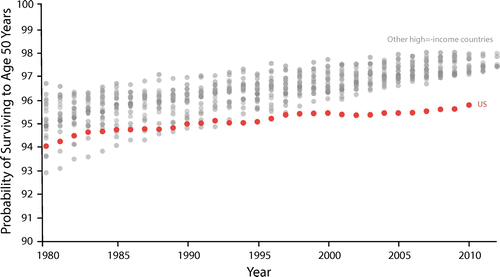
Here is one example of what I would love to hear presidential candidates discuss in at least one debate: the 2013 report from the National Academy of Medicine (NAM) called “Shorter Lives, Poorer Health.”1 It is a 394-page indictment of our nation’s health and health care systems. Here is the opening:
The United States spends more money on health care than any other country. Yet Americans die sooner and experience more illness than residents in many other countries. While the length of life has improved in the United States, other countries have gained life years even faster, and our relative standing in the world has fallen over the past half century.1(p.ix)
Extensive research confirms “a large and rising international ‘mortality gap’ among adults age 50 and older,”1(p.1) according to the NAM panel.
The U.S. health disadvantage cannot be attributed solely to the adverse health status of racial or ethnic minorities or poor people, because recent studies suggest that even highly advantaged Americans may be in worse health than their counterparts in other countries.1(p.1)
The report’s comparison group includes Australia, Austria, Canada, Denmark, Finland, France, Germany, Italy, Japan, Norway, Portugal, Spain, Switzerland, the Netherlands, and the United Kingdom using data between the 1990s and 2008. The health disadvantage was sharpest in nine health domains:
Adverse birth outcomes—the highest infant mortality rate among high income countries;
Injuries and homicides—a leading cause of death in children, adolescents, and young adults;
Adolescent pregnancy and sexually transmitted infections—the highest rate of pregnancies among high income countries;
HIV and AIDS—the highest incidence of AIDS and the second highest prevalence of HIV infection;
Drug-related mortality—more lives lost to alcohol and drugs than in any other nation, even when excluding drunk driving deaths;
Obesity and diabetes—the highest rates of obesity and diabetes among high income nations;
Heart disease—the second highest rate among 17 peer nations;
Chronic lung disease—higher mortality than in the United Kingdom and other European countries; and
Disability—one of the highest prevalence rates of activity limitations among older adults.
The NAM results are not totally bad and include higher survival after age 75 years, as well as better rates regarding cancer, blood pressure and cholesterol levels, smoking, and stroke mortality. Of note, given recent public preoccupations in the political campaign, the health status of recent immigrants is better than that of native-born Americans.
Yet,
Americans under age 75 fare poorly among peer countries on most measures of health. This health disadvantage is particularly striking given the wealth and assets of the United States and the country’s enormous level of per capita spending on health care, which far exceeds that of any other country.1(p.4)
The Report is a staggering indictment of our American society in this new century. Back in 1980s, President Ronald Reagan taught the nation the power of positive thinking in shaping attitudes. This report is downer, which may help to explain why it is so hard to break into the national conversation.
Yet it is also true is that in recent years, we have seen other reports that paint a bleak picture of our nation’s health.
In November, a new study by Case and Deaton documented rising morbidity and mortality rates among US Whites aged 45 to 54 years.2 A reexamination of the data by Aron et al. at the Urban Institute revealed a shocking increase in the rate of mortality among middle-aged women three times faster than the rate of increase among similarly aged White males: 26.8 deaths per 100 000 population among White women aged 45 to 54 years versus a 7.7% increase among men between 1999 and 2013.3Figure 1 supports Aron et al.’s conclusion:
There is simply no mistaking the reality that American women are currently dying much earlier than their counterparts in other advanced nations … [including] women of reproductive and childrearing ages, a finding that has huge implications for children, families and communities.3
And not to let US health care off the hook, the performance of our medical care system continues to underwhelm. A recently released study by the World Health Organization and The Economist Intelligence Unit, “Healthcare Outcomes Index 2014,” examining the health care systems of 166 nations, ranked the United States number one in spending and number 33 in quality outcomes, placing it among the least efficient systems on the planet, and ranking behind nations such as Lebanon and Costa Rica.4Figure 2 shows the broad ranges of nations that achieve better results for their societal investments in health care.
I recall in the 1980s reading health economists speculate about “flat of the curve medicine,” the hypothetical point at which further expenditures on medical care could actually produce worse health. Figure 2 illustrates that US spending now is beyond the flat of the curve and that the hypothesized adverse outcomes from outsized medical care spending are now real.
Research over the past five years by Bradley at Yale offers a compelling hypothesis to explain at least part of our nation’s dismal performance—among all advanced nations, the United States spends by far the most on a per person basis on medical care while spending nearly the least on a per person basis on nonmedical social service spending such as education, day care, job training, housing support, nutritional assistance, and more.5 Focusing less on medical care and more on needs relating to the social determinants of health seems to help produce more beneficial population health outcomes than our nation’s prioritization on the reverse. Figure 3 illustrates Bradley’s key findings.
So here we are with an accumulating knowledge base of a deep and profound societal problem. Our approach—or perhaps non-approach—to health is killing us and weakening our nation. Is there a presidential candidate talking about any of this? Yes, Senator Bernie Sanders proposes a Medicare-for-all single payer system that might provide the best opportunity for systemic reorientation. Yet the real-world chances for such a radical redesign do not offer great confidence.
One of the most surprising developments in American politics in recent years has been the emerging common ground from the nation’s political right and left regarding US criminal justice and prison policies that leave us with the world’s highest incarceration rates. From widely diverging ideological perspectives, deeply divided political adversaries are engaging in serious and substantive collaboration to change these policies.
I see the basis for a new conversation between the political left and right regarding our nation’s over-reliance on medical care to address human needs that could far more effectively and efficiently be addressed in preventive and nonmedical ways by tackling the social determinants of health. Surely, citizens who identify as conservatives have no reason to cheer our outsized and debilitating level of spending on medical care. Might we see in the new incarceration dialogues inspiration for a new and path-breaking conversation on how to get our nation’s health care needs and spending in better order?
Although it is already late to get these issues planted in the 2016 national political agenda and campaign, it is not too late to spur conversation and education. While the process for major political change takes time, the work has to begin somewhere. The nation’s public health community has a lot to say and much to contribute to this process.
2. A Case, A Deaton. Rising Morbidity and Mortality in Midlife among White non-Hispanic Americans in the 21st Century. Proc Natl Acad Sci U S A. 2015;112(49):15078–15083. [CrossRef][Medline]
5. EH Bradley, BR Elkins, J Herrin, B Elbel. Health and social services expenditures: associations with health outcomes. BMJ Qual Saf. 2011;20(10):826–831. [CrossRef][Medline]
6. EH Bradley, LA Taylor. The American Health Care Paradox. New York, NY: Public Affairs; 2013.
McDonough is right about two very important things. First, that in America we have quite dismal outcomes for the enormous amount we spend on health care. And second, that there is a real opportunity for a new political dialog between left and right to take root—though perhaps one that is more of a quiet agreement than a high-profile grand bargain.
McDonough wisely draws attention in Figure 3 of his editorial to the sharp distinction between the United States and other Organisation for Economic Cooperation and Development countries in the relative proportions of gross domestic product spent on health services and social services. The United States is a lonely outlier because we overmedicalize our approach to health conditions and community health. Generally a blend of social, housing, public health, and other preventive strategies would yield better health results than calling an ambulance—and at a fraction of the cost. Even our higher survival rates after age 75 years is a mixed blessing, as Gawande points out, because expensive and frequent medical interventions may extend age but often not the quality of life.1
The good news, both substantively and politically in this election year, is the growing recognition that addressing the social determinants of health is a key—perhaps the key—to improving health outcomes while slowing the growth in health spending as a proportion of gross domestic product and public spending. McDonough and I agree on that, despite his affection for Bernie Sanders’ utopian Medicare-for-all, which likely would do little to address the underlying cost and outcomes problem.
So how could a new conversation develop, of the kind both we both would like to see? I think on several fronts.
First, building on existing collaboration, serious analysts and policymakers on both sides of the political spectrum should explain more extensively how resources currently restricted to either health care or social services and housing should and could be more routinely braided together. Despite some interesting experiments and demonstrations that allow certain health and housing money to be mixed and used creatively, budget restrictions and payment systems generally make this difficult. We could seek to agree on a mixture of legislative action on payments and budgets, and using Medicaid (Section 1115) waivers, to permit money currently available only for medical services to be used instead for housing and social services where that could be shown to improve the health of individuals in a community.
Second, we could agree on bipartisan steps to allow states to experiment with more creative approaches to alter the blend of strategies they have available to achieve improved health outcomes. Section 1332 of the Affordable Care Act (Pub L No. 111–148) is a start, since it will allow states to propose alternatives to some Affordable Care Act provisions to improve coverage and outcomes without increasing federal costs. McDonough and I agree on using 1332 waivers in this way. But a further step would be legislation to allow states to seek even broader waivers to shift money between health and social service programs. For that to happen, conservatives would have to accept increases in total spending on some social service programs. Progressives would have to accept reductions in health programs and reduce their reluctance to granting states more flexibility. Both would have to accept rigorous evaluation to determine what works and what does not.
And third, there is an opportunity for agreement on empowering intermediary institutions2 in neighborhoods, including charter and community schools, as well as health systems,3 to serve as hubs for integrated approaches to achieving health communities. That approach combines the conservative emphasis on the importance of nongovernmental institutions with the progressive emphasis on community action. Again, systematic evaluation is needed.
Hopefully there can be cross-party congressional support agreement on these themes, as McDonough notes has occurred in alternative sentencing. But it is unlikely in the election season that such themes will be seized upon by presidential candidates. In my view, that is probably good, because presidential elections are about differences, not path-breaking agreements. Better, during this election cycle, to foster positive conversations that cause such themes to be taken out of the election debates, so that they will have broad support for enactment after the Election Day dust has settled
References:
1. Gawande. Being Mortal. New York, NY: Metropolitan Books; 2015.
2. P Singh, SM Butler. Intermediaries in Integrated Approaches to Health and Economic Mobility. Washington, DC: The Brookings Institution; 2015.
3. SM Butler, J Grabinsky, D Masi. Hospitals as Hubs to Create Healthy Communities: Lessons From Washington Adventist Hospital. Washington, DC: The Brookings Institution; 2015.






 Health Stew
