Is the “Triple Aim” a Part of the Problem?

If you care about transforming the delivery of medical care in the U.S., then you should should read a blog post from last week by Paul Levy, former CEO of Beth Israel Deaconess Hospital in Boston and conductor of “Not Running a Hospital.”  It’s titled: “The Triple Aimers Have Missed the Mark.”

For those who don’t know, the “Triple Aim” was the 2008 invention of Dr. Donald Berwick and colleagues from the Institute of Health Care Improvement (IHI) which Berwick triple-aim-graphic1-300x225created in the last 1980s when he also developed the now-essential medical care construct of “continuous quality improvement“.  As Berwick and colleagues articulated in a 2008 article in the journal Health Affairs:
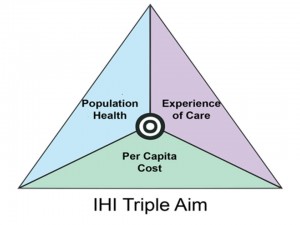
“Improving the U.S. health care system requires simultaneous pursuit of three aims: improving the experience of care, improving the health of populations, and reducing per capita costs of health care. Preconditions for this include the enrollment of an identified population, a commitment to universality for its members, and the existence of an organization (an “integrator”) that accepts responsibility for all three aims for that population.  The integrator’s role includes at least five components: partnership with individuals and families, redesign of primary care, population health management, financial management, and macro system integration.”

One can look at the Affordable Care Act and see the Triple Aim model at work in numerous places.  The key notion behind the Triple Aim is to ask: what are we trying to accomplish in the U.S. medical care system and where are we trying to go?  A quick Google search will give some indication of how far and wide the concept has traveled over the past 7 years, including well beyond U.S. borders.  It is a global phenomenon.

Now comes Paul Levy with a bucket of cold water: Continue reading “Is the “Triple Aim” a Part of the Problem?”
King v. Burwell — The Actuaries Explain All

In the late 1980s, Dr. William Hsiao, a colleague of mine at the Harvard Chan School of Public Health, my former professor, and a globally renowned health economist, explained to me the difference between an accountant and an actuary.  “An actuary is an accountant with a sense of humor,” said he.  Since then, I’ve carried large respect for the professionals who call themselves actuaries.

Their association, the American Academy of Actuaries, has published an issue brief that demands attention: “Implications of Proposed Changes to the ACA in Response to King v. Burwell.  King v. Burwell, if you don’t know, is the case currently before the U.S. Supreme Court that challenges the legality of insurance subsidies being provided to eligible health care consumers in states with federal as opposed to state health insurance exchanges.  A decision is expected in late June.

Straight shooters, they are.  Here are excerpts from their conclusions:

“If federal premium tax credits become no longer available in FFM (federally facilitated marketplaces) states, enrollment in the individual market would decline precipitously among those previously eligible for premium assistance.  Moreover, individuals with high-cost health care needs would be more likely to remain enrolled, while individuals with low-cost health care needs would be more likely to exit the market.  Such adverse selection would cause average health costs, and therefore premiums, to rise…”

“Potentially millions of people would drop coverage, and the average costs of those remaining insured would soar.  Insurers could face solvency concerns, especially those for whom exchange business is a relatively large share of their book of business…”

“…extending the premium subsidies through the 2016 plan year (or longer) could help mitigate these concerns for the short term. … However, if subsidies are made available only to those already receiving them, individuals who would be newly eligible for subsidies, due for instance to a change in income or loss of employer-sponsored coverage, would not benefit from the temporary premium subsidy extension.  This would lead to lower overall enrollment in the individual market, as some individuals would transition out of coverage, but few would transition in…”

“Even if a temporary extension of premium subsidies would help avoid disruption in the short term, it is likely that the disruption would only be delayed, not avoided altogether.  If the subsidies are ultimately eliminated, potentially millions of individuals will drop coverage and premiums will increase substantially…”

“Weakening or eliminating the individual mandate could result in adverse selection that would raise premiums and threaten the viability of the market … although such voluntary incentives would provide incentives for healthy individuals to obtain coverage when first eligible, they would likely not be as effective as a strong individual mandate.”

A lot of damage would be done.  Anyone who suggests they know how the Court will decide is deluded.  No one, no one, predicted the outcome of the 2012 SCOTUS decision on the constitutionality of the individual mandate.  No one knows the outcome of this case either.  But, thanks to the Actuaries, we do know the results of a decision against the government.

The New Conversation on Affordability and Underinsurance

Just like spring, a new public conversation is busting out across the nation and the topic is health insurance and health care affordability for patients and consumers. The conversation is taking different forms and is beginning to trigger policy proposals. More will come – and when it does, this conversation may well become a charged debate.

Here are two important streams in this conversation:

Cost Sharing: The first stream involves the growth of deductibles, copayments, and coinsurance, especially deductibles, aimed at consumers. This past week, the Commonwealth Fund released a new Issue Brief showing that 23% of adults with health insurance, 31 million, had “such high out-of-pocket costs or deductibles relative to their incomes that they were underinsured.” About 11% of privately insured adults have policy deductibles of $3,000 or more, up from 1% in 2003. Half of these underinsured (51%) “reported problems with medical bills or debt and more than two of five (44%) reported not getting needed care because of cost.” Fully 41% of adults with high deductibles had debt loads of $4,000 or more.  Fully 75% of all consumers now have deductibles on their policies — so if you’re part of the remaining 25%, be grateful! Continue reading “The New Conversation on Affordability and Underinsurance”

Hidden ACA (1) — An Alternative Report Card

In my experience, only a tiny fraction of Americans recognize the variety and depth of policies included in the Affordable Care Act. In fact, a vast array of policies reside in the law’s 10 titles, and so many involve interesting and compelling stories. So I’m going to start using this blog as a place to write about many of these stories, and I will call the series “Hidden ACA” so you know what I’m doing.

To start, I offer an alternative 5-year report card on the ACA. Of late, we’ve seen many columns and op-eds evaluating the ACA on its five year anniversary in March. I offer a different approach – grading the law by evaluating the success or failure of the 10 titles individually. Here’s my summary report card based on an assessment of how each ACA title has been implemented, followed by a more detailed discussion of each:

  1. Quality Affordable Coverage for all Americans — Private insurance reform — Grade A-
  2. The Role of Public Programs — Medicaid — Grade B+
  3. Improving the Quality and Efficiency of Health Care — Medicare and Delivery System Reform — Grade A-
  4. Prevention of Chronic Disease and Improving Public Health — Grade B-
  5. Health Care Workforce — Grade C+
  6. Transparency and Program Integrity — Grade A-
  7. Improving Access to Innovative Medical Therapies — Grade A-
  8. Community Living Assistance Services and Supports — Grade F
  9. Revenue Provisions — Grade A
  10. Strengthening Quality Affordable Health Care for All.

Overall Grade – A-

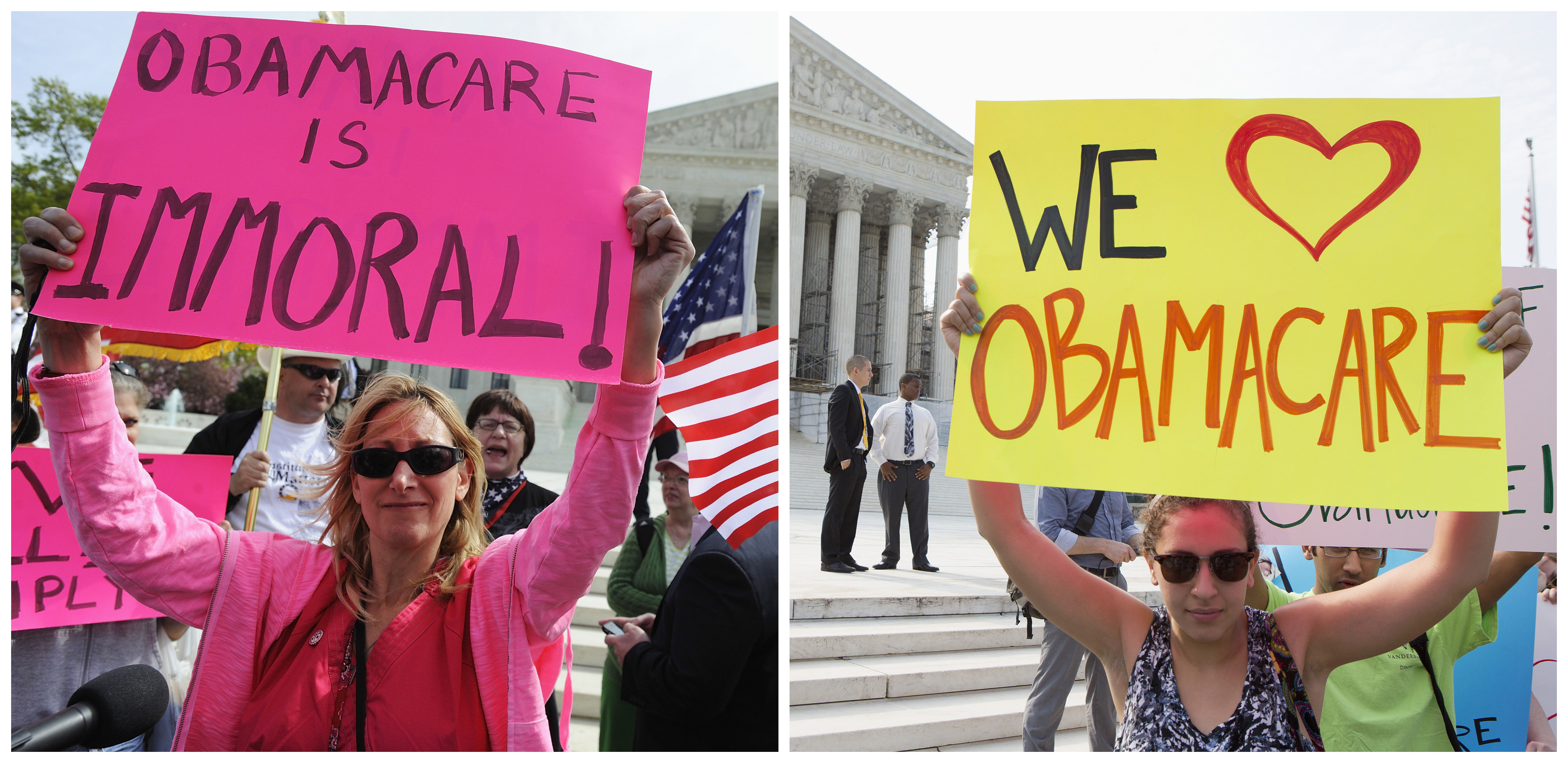
A combination file photo shows opponents (L) and supporters (R) of Affordable Healthcare Act rally on the sidewalk at the Supreme Court in Washington on March 28, 2012 and on June 28, 2012 respectively. The Obama administration said on July 2, 2013 it would not require employers to provide health insurance for their workers until 2015, delaying a key provision of President Barack Obama's healthcare reform law by a year, to beyond the next election.  REUTERS/Jonathan Ernst (L) and  REUTERS/Joshua Roberts (R)  (UNITED STATES - Tags: POLITICS HEALTH) - RTX11B3H
REUTERS/Jonathan Ernst (L) and REUTERS/Joshua Roberts (R)

Let’s consider each Title, one by one: Continue reading “Hidden ACA (1) — An Alternative Report Card”

11.7 + 11.7 = 23.4 million Enrolled via ACA

We had previously  learned in March that an estimated 11.17 million Americans took advantage of private insurance coverage offered through the ACA’s exchange/marketplaces through the second enrollment period ending in February.  Today, we learn that a similar number, 11.7 million, represents the number of low income Americans newly enrolled in Medicaid and the Children’s Health Insurance Program (CHIP) between 2013 and February 2015.  That’s Pappy_O'Daniel's_logo23.4 million Americans directly benefiting from the expansion provisions of Titles I and II of the ACA.

Take a look at the report released last Friday by the US Department of Health & Human Services with the details, including state by state breakdowns.  Some details:

  • From 57,594,096 in September 2013, Medicaid/CHIP enrollment reached 70,515,716 in February 2015
  • 29,245,000 of the 70.5 million are children, nearly 30 million
  • States expanding Medicaid saw enrollments jumps averaging 27%, while the states refusing to expand saw only an 8% increase
  • Eye-popping increases — Kentucky 85%; Oregon 69%; Nevada 67%; New Mexico 51%; Washington 50%; Arkansas and West Virginia 49%; Rhode Island 41%
  • Surprises among non-Medicaid expanding states — North Carolina and Tennessee 16%; Montana 14%; Mississippi 12%
  • Just depressing — Alaska, Nebraska, Utah <1%; Wyoming 1%; Alabama and Missouri 3.5%.

Of course, if the resisting states had expanded Medicaid, we would see approximately 4 million more already enrolled in Medicaid — they will come, it’s just a matter of time (Montana is only the latest, not the last).

Republican lawmakers in DC, by and large, despise Medicaid — during the ACA debate in 2009 on Capitol Hill, Sen. John Cornyn (R-TX) called it the “gulag” of the American health care system.  They say this in spite of the fact that, these days, most of the 70+ million Americans enrolled in Medicaid get their coverage through private managed care plans.  Oh well, as Governor Pappy O’Daniel remarked in the movie, “O Brother, Where Are Thou,” “there ain’t no accountin’ for taste.”  The Romans, more elegantly, would have said: “De gustibus non est disputandum.”

Here’s something that’s hard to dispute.  More and more Americans are coming to appreciate Medicaid as a reliable and affordable source of health insurance coverage.

The Good News and the Bad — Another ACA Day

If you’re like me — and I pray you’re not — your email inbox drowns every day with news about the ACA and health policy in every imaginable direction.  Sometimes, two messages get juxtaposed next to each other in ways that illuminate a higher truth.  I felt that way today.

First, came an email update from the Urban Institute and their Elevate the Debate project.  Just look at these headlines, all based on newly released data:

Brief30Fig1TOPBig things, good news.  I am especially impressed with the drop in uninsurance among adults with chronic health conditions such as diabetes, cardiovascular disease, hypertension, and asthma.  Real progress and something to feel good about.

Then, the next email is from the Blue Cross Blue Shield Foundation of Massachusetts offers a wealth of new data on rising health insurance costs, especially deductibles and other cost sharing, confronting Massachusetts health consumers: Rising Health Care Costs in Massachusetts: What It Means for Consumers.  What it means is not encouraging:

“The impact of these changes in health insurance products can be seen in spending trends, which show that by 2013, nearly one in ten adults spent over 10 percent of income on out-of-pocket health care costs.  For an insured family of four with an income three times the federal poverty level (about $71,000 in 2013), that represents a burden of more than $7,000 per year over and above the cost of insurance premiums.”

Lots of progress and good news, and lots of discouraging trends as well.  The the Blue Cross data only covers Massachusetts, the same trends are in evidence all over the nation, and worse in many other states.  In the polarized craziness of the ACA, the news has to be all good or all bad, with no room for ambiguity or complexity.  That’s not real and that’s not life.

The ACA is responsible for some of the most important gains in social and economic justice in our lifetime.  And, we still have many vitally important gaps to close and gains yet to be made.  That’s reality.


Advertising the ACA’s Winners

In the five-plus years since the signing of the Affordable Care Act in March 2010, precious little media advertising has been purchased to promote the law and its benefits for so many Americans.  This failure has happened in the context of an avalanche of negative advertising funded by the law’s many affluent opponents.  Hence, one important element that explains the law’s lack of broader popularity.

In the time leading up to the US Supreme Court’s expected decision in late June on the King v. Burwell suit that could eliminate health insurance subsidies for nearly 10 million working Americans, the Community Catalyst Action Fund has attracted some $250,000 in support to launch some pro-ACA advertising with an explicit political pitch and punch.  It will run only a few times during shows such as Meet the Press and Face the Nation.  You can see the ad below:

More important will be the push to get the ad out and around social media.  The point is to help folks make the connection between this abstract lawsuit and their political power.  Let me know what you think of the ad — and if you like it, please circulate it around.  (Disclosure: I sit on the board of the CCAF which is affiliated with Community Catalyst.)

Diagnosing Vermont’s Single Payer Crash

I have a commentary in this week’s New England Journal of Medicine on “the demise of Vermont’s single payer plan.” Beyond what’s in the article, here are some points of note.

First, as some of ardent single payer proponents note, the plan was never “pure” single payer because VT Gov. Peter Shumlin never envisioned including Medicare in the system.  So it would have been single payer — except for Medicare and other federal programs that would have been challenging to include.  Though including Medicare in the original plan would, quite likely, have been politically suicidal, the point is well taken.

VermontSP

Second, Vermont’s move in this direction in 2011 was the most exciting and important pro-single payer development in a generation at least.  A state chief executive with a strongly Democratic legislature in a small, progressive and compact state — one could hardly imagine a more auspicious opportunity.  Add to that the disappointment among so many Democrats in 2010 that the Affordable Care Act did not go further.  I admit to being caught up in the exuberant enthusiasm. Continue reading “Diagnosing Vermont’s Single Payer Crash”

11.9% Is the New Normal

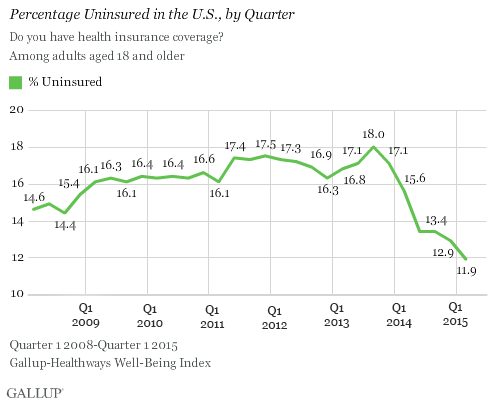
The Gallup organization has become the go-to sources for monthly tracking of progress in reducing the numbers of uninsured Americans.  Yesterday, they came out with their latest estimate that the percentage of American adults without health insurance has now dropped to Gallup201511.9%, down from 18%in mid-2013, and down from 12.9% in late 2014.  Because rates of coverage are higher among children, the overall uninsurance rate among all Americans is lower, though no precise estimate is include.

If you look at the chart, it’s unmistakeable that the drop in coverage began with the implementation of the major Affordable Care Act insurance coverage expansions that took full effect on January 1 2014.  Of course, if all 50 states — instead of the current 28 — joined the Medicaid expansion for poor adults, then the rate would be substantially lower, especially with the addition of states with very high rates of uninsured adults such as Texas, Florida, North Carolina, Georgia, Louisiana, and others.

We can hope that 11.9% will not be the new normal for long and that the next new normal will be even lower.  This achievement is a victory for Americans everywhere working so hard to make sure that everyone benefits from the ACA.  Below are some more details — you can see that the expansions are working precisely as intended, and that the groups benefiting the most are those with the highest rates of uninsured: the young, those with lower incomes, and racial/ethnic minorities. Gallup2


Reality and Unreality in the New Congressional Medicare (SGR) Deal

This week, you can be confident that the US Senate will approve bipartisan legislation approved on March 26 in the House of Representatives by an overwhelming (392-37) bipartisan majority to repeal a long-standing feature of Medicare physician payment policy called the Sustainable Growth Rate or SGR.

If you’ve never heard of SGR, you are among the 99%. Still, the SGR story has been fascinating and frustrating since it began as part of the 1997 Balanced Budget Act (BBA) agreed to by President Bill Clinton, House Speaker Newt Gingrich, and Senate Majority Leader Trent Lott.  And as SGR begins its final exit, a host of good and not-so-good elements in the repeal legislation come into play. Nancy+Pelosi+Congressional+Leaders+Honor+Fresco+DnF8pOwGvVhl

What’s good and what’s not so good about this deal?  Well, everything, depending on your point of view.  Here are the leading candidates (and my grade):

  • Repealing SGR – very good
  • Refinancing the Children’s Health Insurance Program (CHIP) for two years – very good (excellent if it were for four years)
  • Authorizing $7.2 billion for community health centers and the National Health Service Corps – wonderful!
  • Replacing SGR with a more sensible set of physician payment quality incentives (that follow the logic of the ACA, believe it or not) – very good
  • Not paying for the $141 billion 10-year cost of SGR repeal to the federal Treasury – not so good though worthy of forgiveness this time

So, wow.  Does this augur a new era of bipartisan Congressional cooperation on health policy?  Nope.  Let’s look at each of these in turn. Continue reading “Reality and Unreality in the New Congressional Medicare (SGR) Deal”